The plaza locals treat as the city's kilometre zero — the Chairman Mao statue to the north, two free museums on either side, and Chengdu's busiest metro interchange right beneath your feet. Free and open all day.
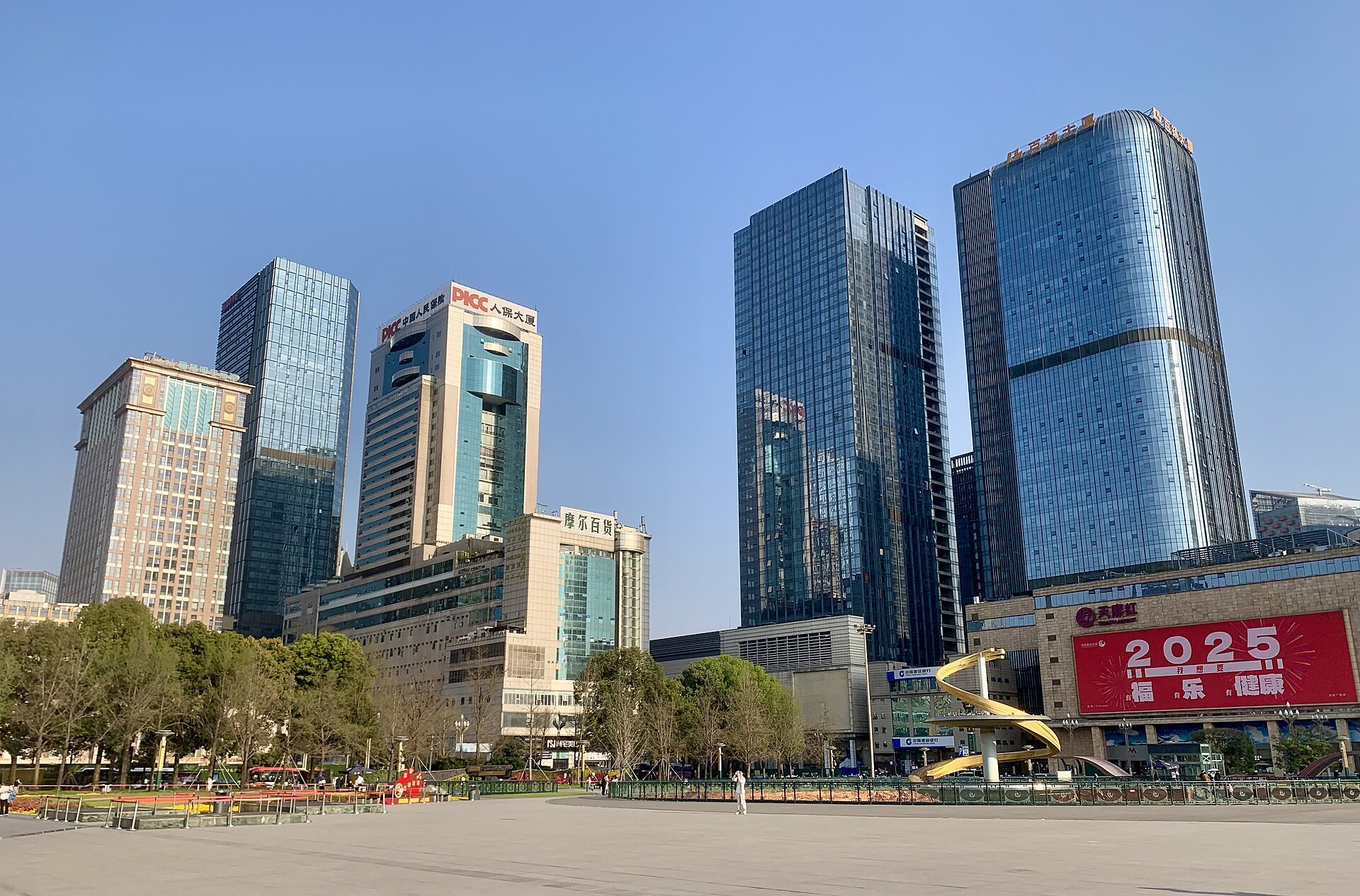
Picture your first morning in Chengdu: you take the metro in from the airport or the railway station, ride the escalator up, and surface onto a wide stone plaza in the middle of the city. Glass towers reflect the sky on every side. In the centre, set in black-and-white granite, is a golden sculpture of the sun and sacred birds — the symbol of Chengdu. And to the north stands a 30-metre statue of Chairman Mao Zedong, right hand raised, facing south over the square. This is the point locals use to fix the whole city in their heads.
This is Tianfu Square — the central plaza that functions as Chengdu's kilometre-zero reference point. The main avenues fan out from here and the metro system crosses directly underneath it. Around the edges sit the institutions that matter: the Chengdu Museum, which tells the story of the ancient Shu kingdom; the Sichuan Science and Technology Museum, behind the Mao statue; and the provincial library. It is a public square and a cluster of free museums in the same place.
What makes it the right first stop is straightforward: free, open all day, the easiest place in the city to reach, and the one spot where you can actually see how Chengdu is laid out. Get your bearings here and everywhere else falls into place.
Everything is within walking distance of the centre — start at the north and work around.
A large white statue facing south over the plaza, right hand raised toward the city. It is the most recognised photo spot and meeting point on the square, with the Sichuan Science Museum directly behind it. The classic shot is taken from in front of the statue, looking back across the plaza at the ring of towers.
A large building of roughly 60,000 square metres with more than 20 exhibition halls across several floors, covering engineering and science in a hands-on way — from the Dujiangyan irrigation system to aerospace, robotics and virtual reality. Genuinely good for children. Open roughly 9.30 am to 5 pm, Tuesday to Sunday; register with your passport for free entry.
A modern building tracing Chengdu's history back to the ancient Shu kingdom, with strong displays of Chinese shadow puppetry and Sichuan opera, plus rotating international exhibitions. Open roughly 9 am to 5 pm (until 8.30 pm on Fridays and Saturdays); closed Mondays. Free, but reserve a time slot in advance via WeChat, particularly on busy weekends.
The plaza is paved in black-and-white granite laid out as a yin-yang taiji pattern, flanked by water pools and the gilded "Golden Sun Bird" motif (金沙太阳神鸟) — the design excavated at the nearby Jinsha archaeological site that became the emblem of Chengdu. It is a popular photo spot, best when sunlight catches the gold.
Under the plaza is the interchange between Metro Line 1 (north-south) and Line 2 (east-west). The underground level has an open circular concourse and passages through to an underground mall, and it connects to almost everywhere in the city — the north and south railway stations, the Chunxi Road shopping district and Jinli among them.
The square is a wide, open stone plaza. Walking around it, photographing the Mao statue, the sun-and-sacred-birds sculpture and the surrounding towers takes about 30 to 60 minutes at an easy pace. In daylight the sun catches the gilded sculpture; in the early evening the towers around the plaza start to light up — two quite different moods.
It is a strong place to start your first day in Chengdu. Stand in the middle and you can see how the city radiates out from here — which way the shopping streets are, which way the temples, which way the river. Get oriented, then set off.
The real draw at Tianfu Square is the two museums sitting side by side, both free. The Chengdu Museum on the west side suits anyone who likes history and culture; the Sichuan Science and Technology Museum behind the Mao statue is the one for children or for anyone who enjoys hands-on science. Allow 1.5 to 2 hours for each.
Both close on Mondays and both require passport registration to enter. The Chengdu Museum is best booked in advance via WeChat, especially on weekends. Opening times can change, so check before you go.
The square has water pools that are sometimes run as a musical fountain show with lights after dark — a favourite with locals and visitors alike. But the schedule is not fixed: it depends on the season, the weather and special occasions, and the fountains are switched off entirely during some periods for maintenance.
If you are coming specifically for the fountains, aim for the early evening after sunset, the most likely time for them to run, and ask at your hotel or check current information before you set out. Don't treat any single time as guaranteed — it changes.
Because it sits at the exact centre of the city, Tianfu Square is the easiest place in Chengdu to reach — the metro brings you straight up onto the plaza.
All within walking distance, or a few metro stops, from the city centre