One of the greatest archaeological finds of the 20th century — more than 8,000 life-size clay soldiers standing in formation at Lintong, 40 km east of Xi'an, and not one of their faces is the same.
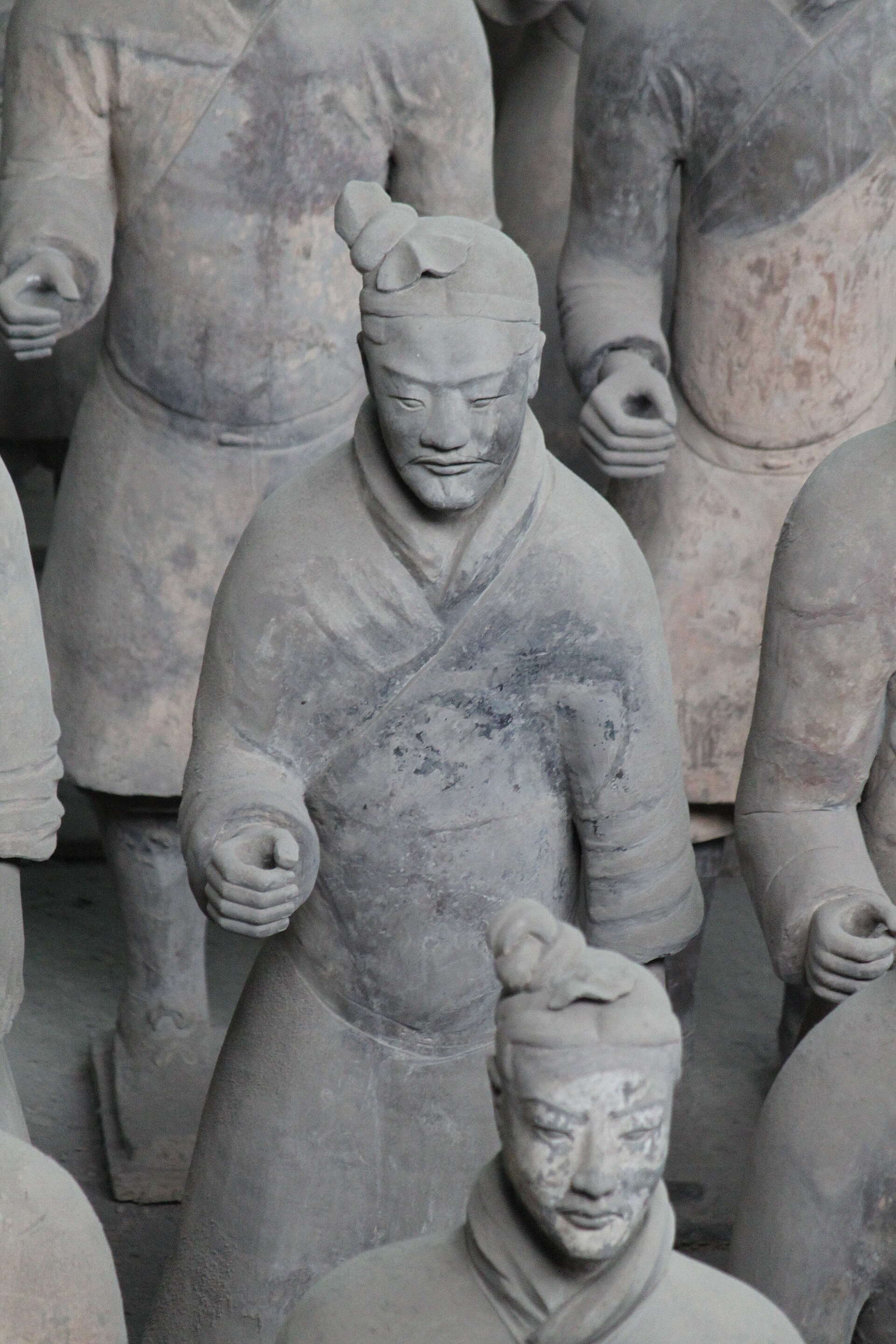
Picture this: you walk into a building the size of an aircraft hangar and look down into a pit, and below you, rank after rank of life-size clay soldiers stretch back further than you can see — thousands of them, all facing east, ready for battle. Lean over the railing and you notice something that stops you: no two faces are alike. One has heavy brows, another hollow cheeks, a third the topknot of an officer. It is as if a sculptor used a different real soldier as the model for each one.
This is the Terracotta Army — the force that Qin Shi Huang (秦始皇, the first emperor to unify China) ordered built in the 3rd century BC to guard his tomb in the afterlife. It lay buried and silent for over two thousand years until 1974, when a group of farmers digging a well struck a clay head — the accidental discovery that triggered an excavation which astonished the world. The site was inscribed as a UNESCO World Heritage Site in 1987.
More than 8,000 warriors and horses have now been unearthed across three main pits, along with a pair of exquisitely cast bronze chariots — all within one museum complex at Lintong. If you only see one thing in Xi'an, this is it.
One ticket covers everything. Follow this order and you'll catch the highlights and finish on the most dramatic.
The biggest and most iconic pit, housed in a hall as long as several football pitches. Inside, life-size infantry stand in eleven long columns facing east in battle order — this is the view everyone photographs. Walk to the far right end to see the section where archaeologists are still reassembling broken figures: you watch warriors being pieced back together from genuine fragments.
This pit shows several arms of the army together — kneeling archers, cavalry with their horses, and senior officers. Much of it remains deliberately buried (the museum is waiting for better paint-conservation technology), but glass cases display standout figures close up, such as a remarkably intact kneeling archer. You can see the tread under his shoes and the detail of his armour far more clearly than anywhere else on site.
The smallest pit but a significant one, believed to be the army's command headquarters. It holds around 68 figures — senior officers and a command chariot — fewer in number but the most finely crafted of all. You can move through it quickly, but take a moment to notice how the layout differs from the battle pits.
Do not skip this building. Inside are the two bronze chariots unearthed near the burial mound itself, each assembled from thousands of gold and silver pieces. The second has a closed cab and gold-and-silver harness fittings, and ranks among the most intricate ancient bronze castings in China — it's where many visitors linger longest.
Included in the same ticket, this is the area of the emperor's actual burial mound (the tomb itself remains unexcavated), with a free shuttle running between the warrior museum and the garden. It suits anyone with time who wants the context of who all these soldiers were built to guard. Skip it if you're short on time, but if you can spare another 1–1.5 hours it's worth seeing the full picture of the mausoleum.
The museum is at Lintong, about 40 kilometres east of central Xi'an — there's no metro straight to it, but it's an easy trip with three main options.
This is the thing visitors trip up on most often: the museum no longer sells tickets at the gate. You must book online in advance (through the museum's official website or WeChat account, up to 7 days ahead), and there is a daily cap on numbers — tickets sell out fast on public holidays. Entry is around ¥120 per person (~฿600) in the regular season, rising to about ¥150 in peak season. The ticket covers Pits 1/2/3, the Bronze Chariots Hall and Lishan Garden, including the internal shuttle.
If the Chinese booking system isn't easy for you (it usually needs a Chinese phone number or passport registration), the simplest route is a tour or ticket package through Klook that handles it for you.
Arriving at opening, 8.30 am, is the single best move. The big tour coaches tend to arrive from late morning through midday, and by afternoon Pit 1 can be too crowded to get to the railing. Come at opening and you'll have space at the front and far clearer photos.
Avoid China's long public holidays without exception — Labour Day (1–5 May) and National Day / Golden Week (1–7 October) are the busiest of the year. July and August bring both fierce heat and crowds. The most comfortable seasons are spring (March–May) and autumn (September–November), especially on weekdays.
The figures in the pits have little detailed signage, so without context you simply see "a lot of clay soldiers." But the story behind them — why every face differs, why the once-bright paint vanished the moment it met the air, who was conscripted to build them — is what brings the pits alive.
English-speaking guides can be hired at the entrance, or come with a pre-booked tour that includes one. Most visitors find that far more rewarding than the museum's own audio guide. If you're doing it independently on a budget, reading up a little beforehand helps a great deal.
Huaqing Palace (the imperial hot-spring complex) is on the same 306 bus route, about 10 minutes before the warriors — two sights in one day makes excellent sense.