Home Shanghai China Shanghai Hotels About
Home  ›  China  ›  Shanghai  ›  Day Trips
Shanghai Day Trips · 2026

Half an hour on the train
and you are somewhere else entirely

Shanghai Hongqiao station is one of the great rail hubs in Asia. UNESCO gardens to the west, a famous lake to the south, ancient water towns in every direction — six day trips you can do before dinner.

Why Shanghai is the perfect base

The Yangtze Delta at your door

There is a reason serious travellers use Shanghai as a base rather than just a destination: Shanghai Hongqiao station connects to the entire Yangtze River Delta by high-speed rail, and the distances that once took hours by car now take twenty-five to sixty minutes. A second-class ticket to Suzhou costs roughly ¥40 (about US$5.50 / ฿200). To Hangzhou, ¥73. These are not long journeys — they are commutes.

The six day trips below represent the best return on time from Shanghai. They are ranked by travel time, starting with the closest. Before you go, read our China high-speed rail guide — it covers the 12306 app, how to buy tickets with a foreign passport, and what to do if a train is full.

🚄
Rail Guide
China High-Speed Rail for Visitors — 12306 app, passport tickets, G/D/C train classes explained
Read the rail guide →
6 day trips from Shanghai

Out in the morning, back for dinner

Ranked by travel time — fastest first.
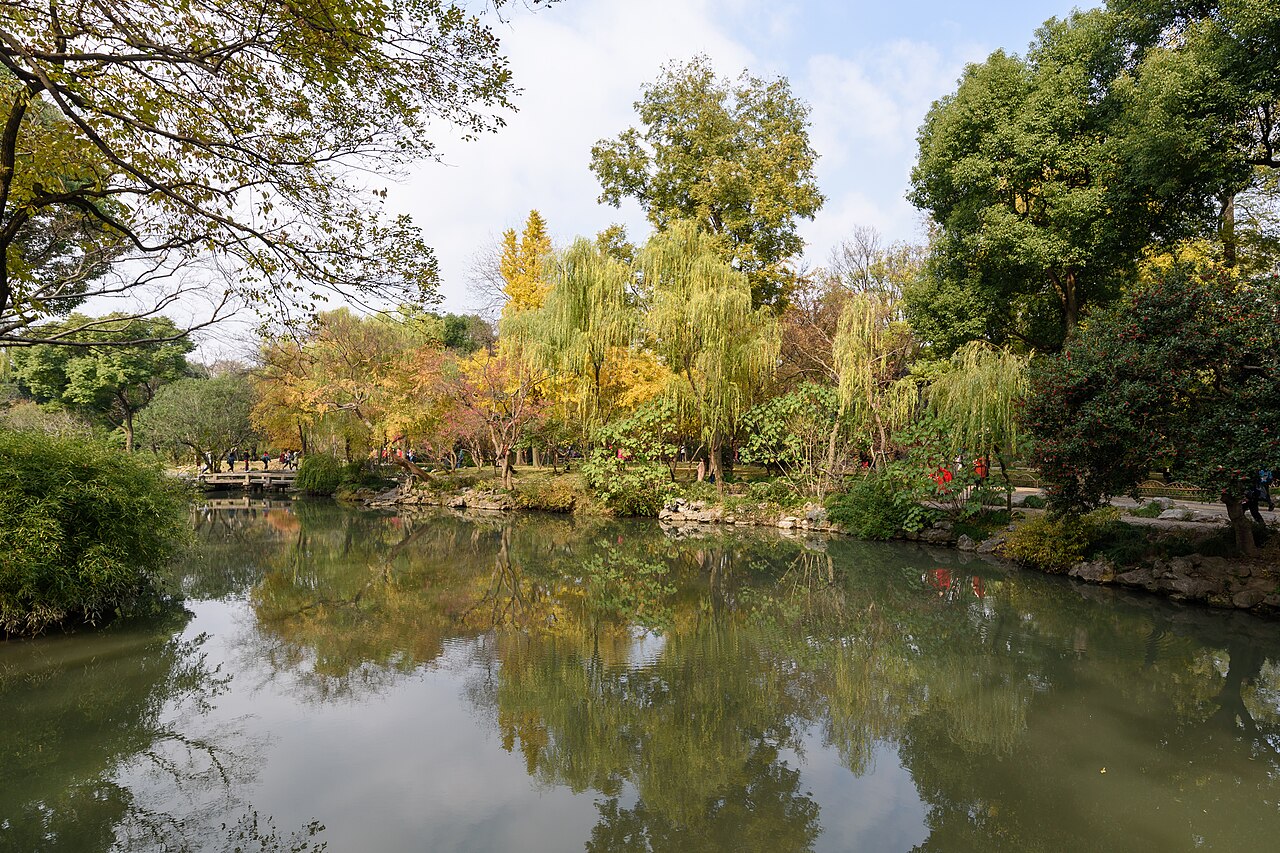
The Humble Administrator's Garden in Suzhou — autumn willows reflected in a still pond, classical Chinese garden architecture, UNESCO World Heritage Site 1
Suzhou (苏州)
Venice of the East · UNESCO classical gardens · Pingjiang canal street · silk

If you have ever seen a photograph of a classical Chinese garden — still water reflecting a curved grey roofline, old trees framing a moon gate, a carved stone bridge that seems designed for contemplation rather than crossing — that photograph was almost certainly taken in Suzhou. The city has sixty-nine classical gardens on record and nine of them are UNESCO World Heritage Sites. The largest and most celebrated is the Humble Administrator's Garden (拙政园 Zhuozheng Yuan), built in 1513, covering about 5.2 hectares of ponds, pavilions, bamboo groves and deliberately winding paths designed to reveal themselves slowly. Two to three hours is the minimum to do it justice.

After the gardens, walk to Pingjiang Road (平江路) — a canal-side street whose layout has not changed since the Song Dynasty. Whitewashed buildings with black trim line both banks. Tea houses, silk shops and local snack stalls occupy the ground floors. It is the living version of Suzhou rather than the preserved version, and the contrast makes both feel more real.
Getting there: G or D train from Shanghai Hongqiao (虹桥) to Suzhou station: 25–30 min
Fare: ~¥40 (~฿200 / ~US$5.50) second class, one way
From Suzhou station: MRT Lines 4 or 5 to gardens — 10–15 min
Time needed: Half a day for one garden + Pingjiang Road · full day for two or three gardens
Garden tickets: ¥90 / person (Humble Administrator's Garden · book online)
Tip: Gates open at 7.30 am — arrive early to beat tour groups that arrive from 9 am
Best time: Autumn (Oct–Nov) for golden foliage reflected in the ponds · Spring (Mar–Apr) for plum blossom and wisteria · Avoid Golden Week (first week of October) — the gardens are genuinely difficult to move through
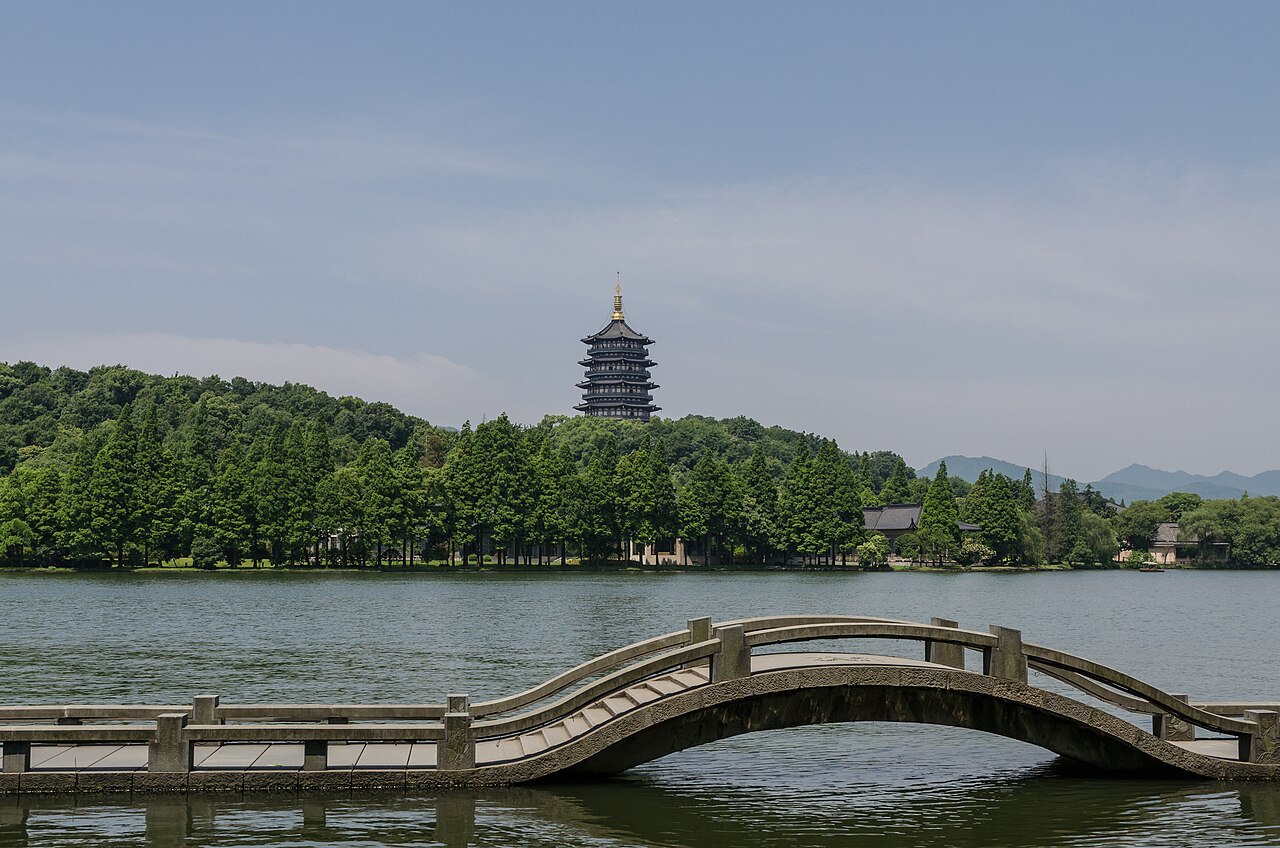
Leifeng Pagoda rising above the wooded hills of Hangzhou's West Lake, stone arch bridge in the foreground, UNESCO World Heritage landscape 2
Hangzhou (杭zhou)
West Lake UNESCO · Lingyin Temple · Longjing tea villages

Marco Polo called Hangzhou "the finest and most splendid city in the world," which is the kind of claim that should be treated with scepticism — except that standing at the edge of West Lake (西湖 Xi Hu) on a still morning with mist sitting on the water and Leifeng Pagoda rising through the trees on the southern shore, you feel the pull of the superlative. The lake is a UNESCO World Heritage Site and, unusually for a Chinese landmark, free to enter. Rent a bicycle to circle the 15-km perimeter, or hire a wooden rowboat for the hour. The Su Causeway cuts straight across the middle of the lake on a raised path lined with willow and peach trees — it is the best walk in Hangzhou.

Lingyin Temple (灵隐寺), one of the most significant Buddhist temples in China, is a twenty-minute bus ride from the western lake shore. The cliff face approaching it is carved with hundreds of stone Buddhist figures — some dating to the tenth century, some recent restorations, all in the same worn grey limestone. The Longjing tea villages (龙井茶村) further west produce the tea that was once reserved for the imperial court; you can sit in a farmhouse, drink tea just picked and poured, and watch the pickers work on the hillside above.
Getting there: G train from Shanghai Hongqiao to Hangzhou East station: 55–65 min
Fare: ~¥73 (~฿365 / ~US$10) second class, one way
From Hangzhou East: MRT Line 1 to Longxiangqiao (lake area) — 20 min
Time needed: Full day — leave Shanghai before 8 am to fit the lake, Lingyin and tea villages
West Lake entry: Free · rowboat hire ¥80–150/hr · bicycle hire ¥20–30/hr
Tip: Lingyin Temple charges ¥75 entry; the cave sculptures outside the main gate are the most atmospheric part
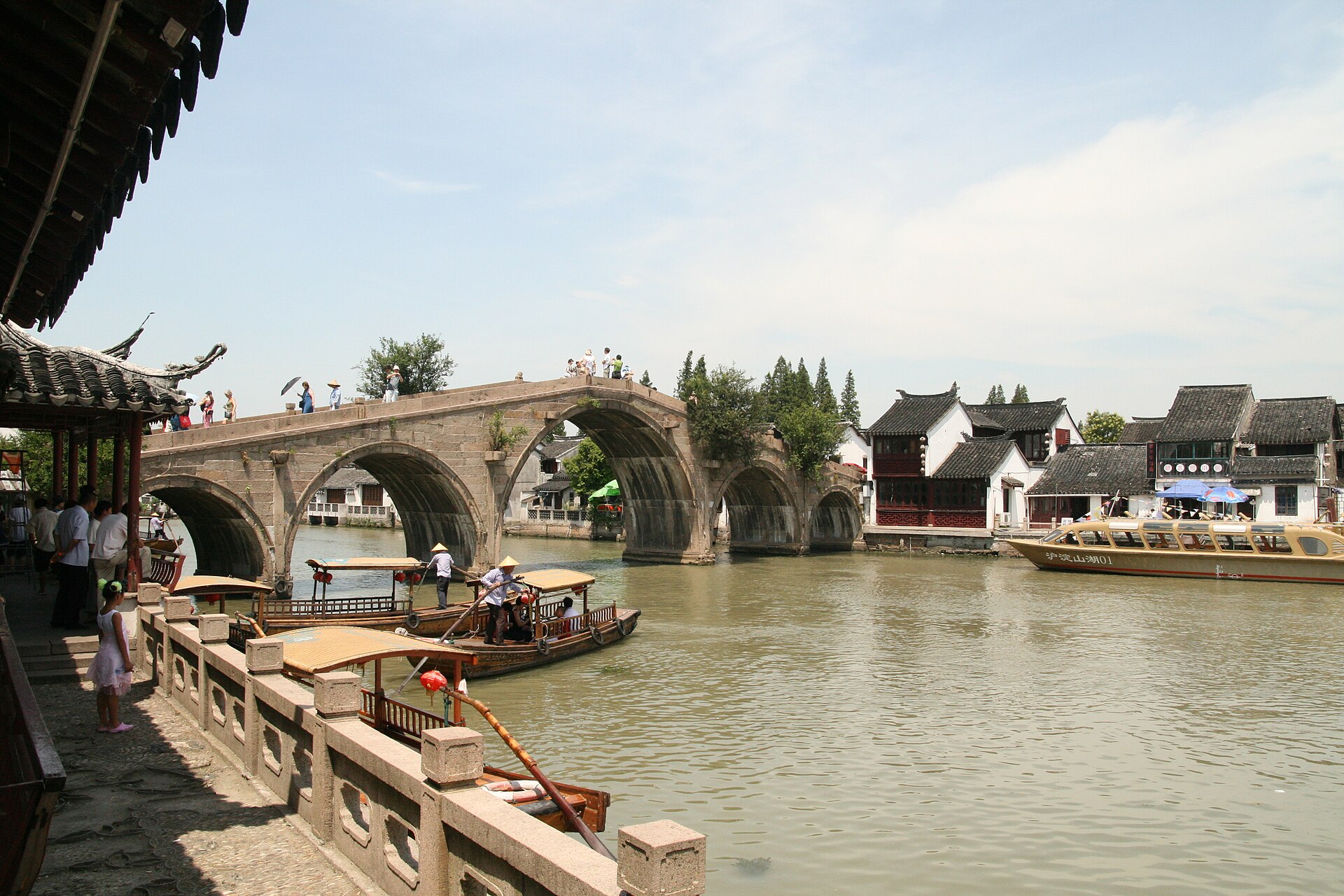
Fangsheng Bridge — a five-arch stone bridge over the main canal in Zhujiajiao ancient water town, traditional buildings along the bank, wooden gondolas moored below 3
Zhujiajiao (朱家角)
Ancient water town within Shanghai itself · MRT Line 17 · half a day is enough

The practical case for Zhujiajiao is compelling: it sits within Shanghai's Qingpu district, reachable on MRT Line 17 from Hongqiao Railway Station in about fifty-five minutes, with no intercity train ticket needed, no advance booking, no passport required at the gate. Tap your transit card or Alipay and go.

The town itself is 1,700 years old. Canals thread between Ming and Qing dynasty buildings whose whitewashed walls and dark timber frames lean gently over the water. The centrepiece is Fangsheng Bridge (放生桥) — the largest five-arch stone bridge in the Yangtze Delta, 72 metres long, built in 1571. You can hire a gondola-style wooden boat (¥100 for about 40 minutes) to paddle slowly through the narrower back canals, or simply stand on the bridge and watch the world pass. Street food in the lanes around the bridge — soft tofu, red-bean pastries, steamed pork buns from elderly vendors — costs less than ¥10 per item. This is an easy half-day from central Shanghai that almost always delivers.

Getting there: MRT Line 17 from Hongqiao Railway Station to Zhujiajiao: ~55 min
Fare: ¥7 (~฿35) — use Shanghai transit card or Alipay
Town entry: Walking the streets is free · some historic buildings charge ¥30–60
Time needed: 3–4 hours is comfortable · full day if you want to linger over lunch
Tip: Go on a weekday morning — Saturday and Sunday draw large crowds from central Shanghai
🏮4
Wuzhen (乌镇)
China's most atmospheric water town · black-timbered canals · best after dark

If there is a single image that most people carry in their heads when they imagine a Chinese water town — black-timbered buildings closing overhead into a narrow corridor, a canal the colour of jade beneath, lantern light shattering on the water at night — that image comes from Wuzhen. The town is not a reconstruction. It has been lived in continuously, the architecture is genuine, and the management of tourism here is done more thoughtfully than almost anywhere else in China.

Wuzhen divides into two zones. Xizha (西栅, the western section) is the larger and better-developed for visitors: guesthouses, restaurants, a theatre, and a textile museum are spread through the lanes. It stays open until 10 pm, and the night version — walking the canal paths with only lanterns and reflections for light — is genuinely one of the more beautiful things you will see in China. Dongzha (东栅, the eastern section) is older and less managed; locals still live and work there.

One honest caveat: there is no direct high-speed rail to Wuzhen. The practical route is HSR from Shanghai Hongqiao to Tongxiang (~30 min, ~¥35), then a local bus or taxi for another 30–40 minutes. Or hire a car from Shanghai. The total journey is 1.5–2 hours. If you want to see the canal at night, stay one night — day visitors miss the best part.

Getting there: G train Shanghai Hongqiao → Tongxiang (~30 min, ~¥35), then bus or taxi to Wuzhen (~30–40 min, ~¥12)
Total fare: ~¥47 (~฿235) · or hire car from Shanghai ~¥300–400 each way
Entry: Xizha all-inclusive ticket ¥120 / person (includes boat and museums)
Time needed: Full day plus evening — or stay one night to see the canal at its best
Tip: Book guesthouses well ahead during Chinese public holidays — they sell out weeks in advance
🛶5
Zhouzhuang (周庄)
China's most famous water town in the guidebooks · twin Shuangqiao bridges · Ming dynasty mansions

Zhouzhuang earned its fame before most of the other water towns had found their way into travel writing. In 1984, Shanghainese painter Chen Yifei completed a canvas of the Shuangqiao twin bridges (双桥) — one square-arched, one round-arched, built together in the Ming dynasty, their reflection forming what looks like an old-fashioned key or a pair of musical notes. The painting was given to the United States as a diplomatic gift. After that, Zhouzhuang became the international shorthand for "Chinese water town," and it has never entirely stopped being crowded.

The twin bridges are still the reason to go. Beyond them, the town holds Shen's House (沈厅) — a sprawling Qing dynasty merchant's mansion of about 100 rooms that is remarkably intact — and the surrounding Nanhu Lake, which is walkable from the main lanes. The food speciality is whole pork hock braised for hours in soy and rock sugar, sold in small restaurants along the canal: rich, sticky, and excellent with rice.

Be honest about crowds: on weekday mornings in spring and autumn, Zhouzhuang is beautiful and manageable. On weekend afternoons and public holidays, it is very busy. If you want a quiet canal town, Tongli (number 6 below) will suit you better.

Getting there: Bus from Shanghai South Bus Station (上海南站汽车站) direct to Zhouzhuang: ~1.5 hr · or hired car
Fare: Bus ~¥30–40 (~฿150–200) one way
Entry: ¥100 / person (includes main historic sites within the town)
Time needed: Half day to full day
Tip: Arrive before 9 am — the first two hours in the morning are genuinely pleasant before tour groups arrive
🌿6
Tongli (同里)
The quietest canal town · Tuisi Garden UNESCO · pairs well with Suzhou

Tongli is what Zhouzhuang might have been if it had stayed a little further off the tourist circuit. The town sits 18 km south of Suzhou, and most visitors pair it with a Suzhou day — take the train to Suzhou, spend the morning in a classical garden, then catch a bus to Tongli for the afternoon. It also works as a standalone day from Shanghai, but the extra transit time means arriving a little later.

The anchor is Tuisi Garden (退思园 Retreat and Reflection Garden), a Qing dynasty garden that received UNESCO recognition as part of the Classical Gardens of Suzhou designation. Built in 1886 by a military official who had been dismissed from his post, "Tuisi" means "retreat and reflect in solitude." The garden is smaller than the great Suzhou gardens, but the mood it creates is distinct — everything points inward, toward stillness. Stone islands, water, old trees and viewing pavilions arranged so that each step changes the composition without breaking the silence.

Tongli itself is small enough to walk end-to-end in two hours. That is not a criticism — it means you will have time to sit in a teahouse, watch boats pass, and feel the town rather than consume it.

Getting there: G train Shanghai Hongqiao → Suzhou, then bus to Tongli (~30 min) · or direct bus from Shanghai South Bus Station ~1.5 hr
Fare: Train + bus ~¥60–70 (~฿300–350) · direct bus ~¥40
Entry: Tuisi Garden ¥40 · combined town ticket ¥100
Time needed: Half day · pairs naturally with a morning in Suzhou
Tip: Visiting Suzhou and Tongli on the same day is completely feasible — take the morning train to Suzhou, spend 2–3 hours in a garden, then bus to Tongli for the afternoon
Before you leave your hotel

Practical notes for all six trips

Shanghai Hongqiao Station (虹桥) is the departure point for all the high-speed rail trips on this list. It connects to MRT Lines 2 and 10 — from The Bund or People's Square, count on 30–40 minutes to reach the station. Arrive at least 30 minutes before your train departure: the station is the size of a small airport.

Booking tickets: The 12306 app (App Store / Play Store, English interface) is the official ticketing platform. Register with your passport number before you want to travel. On weekdays outside holidays, window tickets are usually available on the day. During Golden Week (first week of October) and Spring Festival (January or February), book one to two weeks ahead.

Paying for things: Most vendors at canal towns and garden entrances accept Alipay or WeChat Pay only. Download Alipay and link a foreign Visa or Mastercard via its international mode before arriving. Many small food stalls do not accept cash at all. Mid-range restaurants generally accept foreign credit cards.

Frequently asked

FAQ · Day trips from Shanghai

Suzhou or Hangzhou — which is better for a one-day trip from Shanghai?
If you have only one day and love classical gardens, Suzhou is the easier call: 25–30 minutes on the high-speed rail from Shanghai Hongqiao, and the Humble Administrator's Garden is a few metro stops from the station. You can fit two or three gardens plus Pingjiang Road in a full day. Hangzhou requires about an hour each way, plus transit from Hangzhou East station to the lake. If you want a lake, hills and tea villages, Hangzhou is worth the extra time — but leave Shanghai before 8 am.
How long does the train from Shanghai to Suzhou take, and what does it cost?
High-speed G and D trains from Shanghai Hongqiao station reach Suzhou in 25–30 minutes. A second-class ticket costs approximately ¥40 (around ฿200 / US$5.50). Buy via the 12306 app or at station windows with your passport. Read the full guide at China high-speed rail guide.
Which water town is closest to Shanghai and easiest to reach?
Zhujiajiao sits within Shanghai's Qingpu district, reachable on MRT Line 17 from Hongqiao Railway Station in about 55 minutes. No intercity train ticket is required, no advance booking needed — just tap your transit card or Alipay. It makes a relaxed half-day trip and is the lowest-effort water-town experience from Shanghai.
Do I need to book train tickets in advance?
On weekdays, tickets are usually available at the station on the day. During Chinese public holidays — Golden Week in October, Spring Festival in January or February — trains sell out days or weeks ahead. Book via the 12306 app (English interface, foreign passport accepted). See our China rail guide for step-by-step instructions.
How many days do I need in Hangzhou?
One full day is enough if you leave Shanghai before 8 am: you will have time for West Lake, the Lingyin Temple complex and a quick stop at a Longjing tea village, returning to Shanghai by 9 or 10 pm. If you want to walk the Su Causeway at dawn with mist on the water, or sit in a tea house without rushing, one night in Hangzhou transforms it completely.
What is the difference between Wuzhen and Zhouzhuang?
Wuzhen is better managed for visitors: the western Xizha zone has restaurants, guesthouses and stays open at night — lantern-lit canals reflecting black-timbered buildings is the image most people picture when they think of a Chinese water town. Zhouzhuang is more famous in traditional travel writing and has the iconic Shuangqiao twin bridges, but it draws large crowds on weekends and public holidays. For the quietest experience of all, Tongli (closer to Suzhou) is the least visited and most peaceful of the three.
Klook · Day Trips

Shanghai Day Tours — guided trips to Suzhou, Hangzhou and Zhujiajiao

Rather skip the train logistics? Klook's guided day trips include transport, an English-speaking guide, and garden or site entry — leaving Shanghai in the morning, back by evening. No Chinese apps needed.

Browse Shanghai Day Trips on Klook →
Wherebest is an affiliate partner of Klook — we may earn a commission when you book through our links, at no extra cost to you.