Before the city wakes up, Shanghainese are already queuing at the da bing cart, tucking a you tiao into the fold, and drinking hot soy milk from a paper cup on the pavement. A full morning set costs under ¥15. It is one of the great breakfast cultures on earth.
Most visitors to Shanghai eat breakfast in their hotel, check in to the sights by nine, and leave without ever understanding what the city tastes like before it gets going. That is a genuine loss. Shanghai's breakfast culture is centuries old and still completely alive — in the back lanes of Jing'an, the wet market alleys of Xuhui, and the pavements around People's Square where two of the city's most-discussed breakfast spots stand five minutes apart.
The city's morning eating has a name and a canonical form: the "Four Warriors" (四大金刚 · Sì Dà Jīngāng) — da bing, you tiao, ci fan tuan and doujiang. These four have been eaten together in Shanghai since at least the Republican era, and locals eat them still. Around them orbits a constellation of other morning dishes: shengjian bao with their crackling bases, freshly steamed xiaolongbao, griddle-crisped scallion pancakes, pan-fried potsticker dumplings, and silken tofu floating in a savoury broth. The total bill for a thorough morning, sampling several things, will rarely exceed ¥40 per person.
This guide covers each dish honestly: what it is, why it matters, where to find it in the city, and what you need to know to actually get it.
These four items form a complete morning meal. Combined cost: ¥8–15. Locals have been eating this way since before anyone can remember.
Wheat dough rolled thin, scattered with sesame seeds, then baked on a thick cast-iron griddle until both sides are golden and the surface has just enough give to tear cleanly. The classic version is savoury-plain, lightly salted; a sweet version dusted with sugar also exists. The Shanghainese way is to fold a you tiao inside and eat them together — the sesame-scented crust wrapped around the airy, oil-rich dough stick, one crunch answering the other. Two to four yuan per piece, making this the cheapest item in the morning rotation.
Wheat flour mixed with salt, baking powder and a little oil, shaped into a long strip, then dropped into very hot oil. It expands immediately — puffing up, stretching, turning the colour of a sandy beach. Outside: shatteringly crisp. Inside: hollow and yielding. The classic move is to dip it into a cup of warm soy milk, let it absorb just enough liquid to soften slightly, then bite through. You can also fold it into a da bing or break it up inside a ci fan tuan. This is a dish that has been eaten for breakfast in Shanghai since the Song Dynasty, in roughly the same form.
The breakfast engineered for a city that never stops. A layer of freshly steamed glutinous rice is spread on a damp cloth, a crushed you tiao laid at the centre, then zhacai (pickled mustard greens), a drizzle of soy sauce and a scattering of dried pork floss. The cloth is then pulled tight around everything and the whole parcel rolled into a neat oval, firm enough to eat one-handed on the street. The rice is warm and slightly sticky; the you tiao inside has softened a little but still gives some resistance. You will see people eating these while walking, cycling and waiting for the metro. It is filling, balanced and costs ¥5–8.
Fresh-ground soy milk, made that morning, is a different thing from the shelf-stable cartons you may know. In Shanghai it comes two ways: sweet (甜豆浆) — warm or cold, a gentle background sweetness — and savoury (咸豆浆), which is the version worth seeking. Hot soy milk poured over a spoonful of black vinegar: the protein curdles instantly into soft, silken threads. Add fried shallots, dried shrimp, pickled mustard greens and a thin thread of chilli oil. What arrives in the bowl is somewhere between soup and a light custard — warming, savoury, faintly oceanic. It costs ¥3–6 and pairs with everything else on this list.
These sit alongside the Four Warriors in Shanghai's morning rotation. Some stalls sell out by 8.30 am — you have been warned.
5
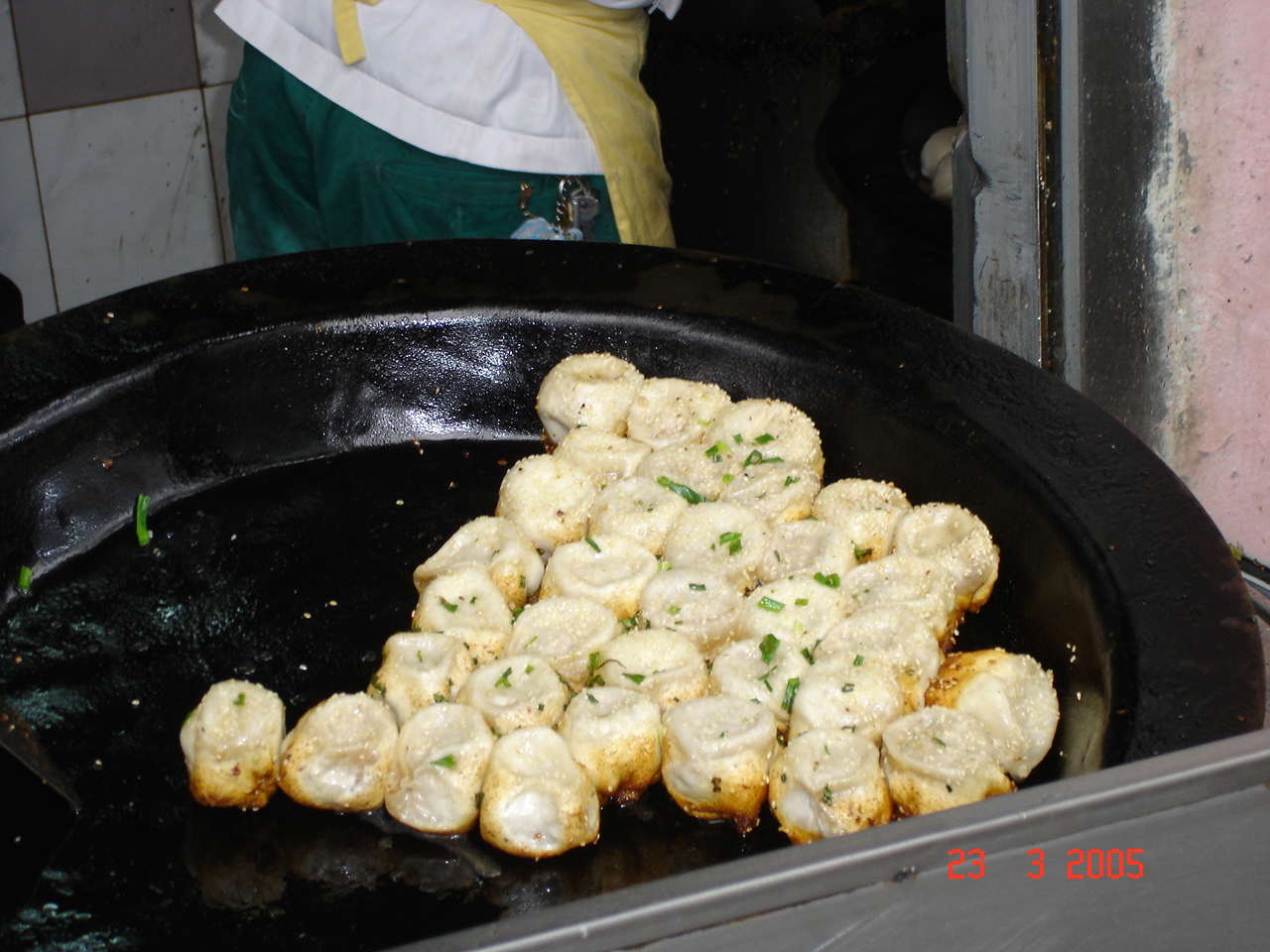
Where the Four Warriors are quiet and intimate, shengjian bao are a performance. A flat-bottomed wok large enough to park a bicycle in. Two hundred buns arranged tight, base-down in oil. A lid on, steam building. Ten minutes, then the lid lifts: the bases have turned a deep chestnut-amber, audibly crunchy when tapped, the tops still white and pillowy, dusted with sesame and spring onion. Bite in and the broth inside releases. At Yang's Dumplings four pieces cost ¥13 and are the best thirteen yuan you will spend in this city. Eat them standing outside the shop; the crust softens as soon as they cool.
6
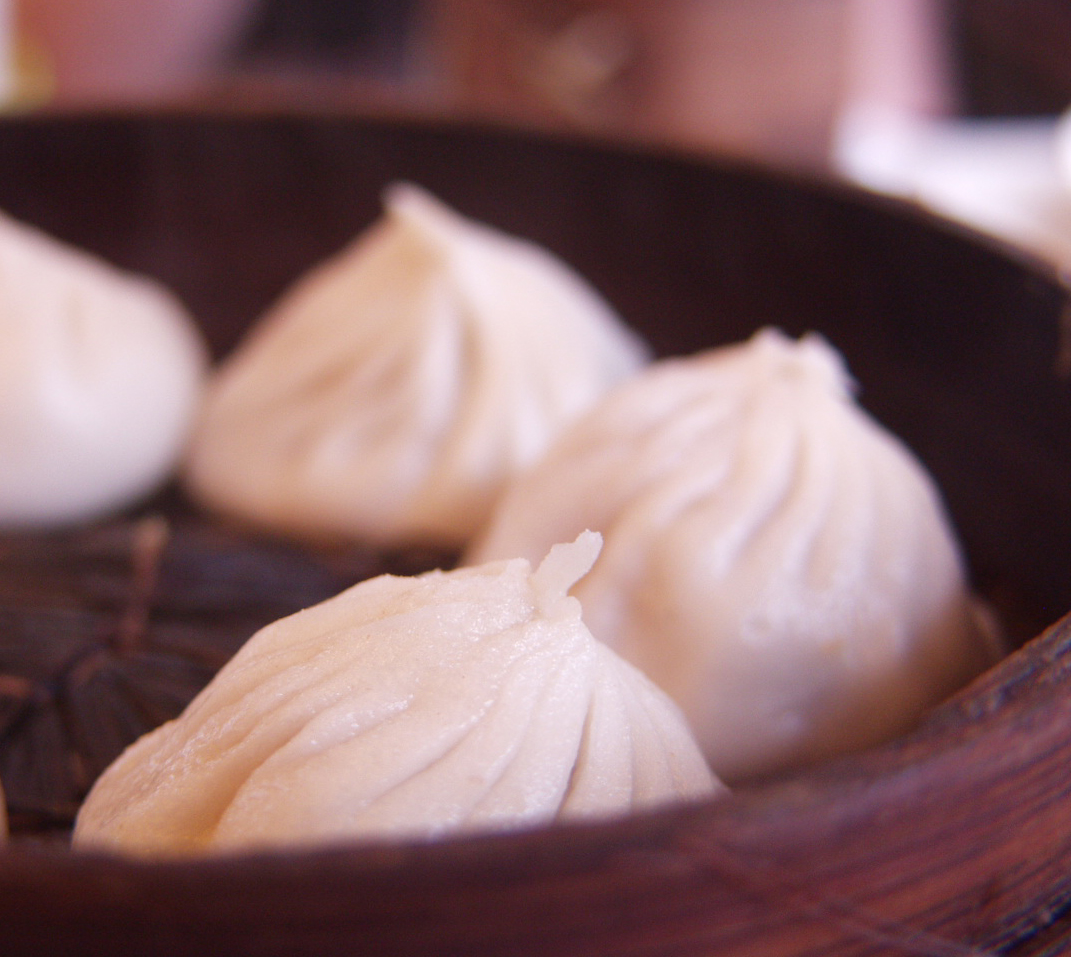
Xiaolongbao are not traditional breakfast food for most Shanghainese — they belong more to the mid-morning tea-house tradition. But Jia Jia Tang Bao on Huanghe Road opens at 6.30 am and fills up fast, and eating a basket of their pork XLB at seven in the morning, with a cup of black tea, while the neighbourhood carts are still setting up around you, is one of Shanghai's better ways to begin a day. The correct technique: bite a tiny hole in the side, count to ten, sip the broth, eat the rest. The wrapper should have at least 18 pleats. Pork-only baskets are ¥32.
A crescent-shaped dumpling — pork and Napa cabbage filling, open at the top — fried base-down in a shallow film of oil until the underside is golden and crunchy, then steamed through the lid until the dough above it is tender. The Shanghainese version tends to be seasoned more gently than its northern Chinese cousins: the pork flavour comes through clearly, the filling stays juicy, the bottom snaps when you bite it. Dip in Zhenjiang black vinegar with fine-shredded ginger. Eight to ten pieces is a solid breakfast alongside a cup of soy milk.
8
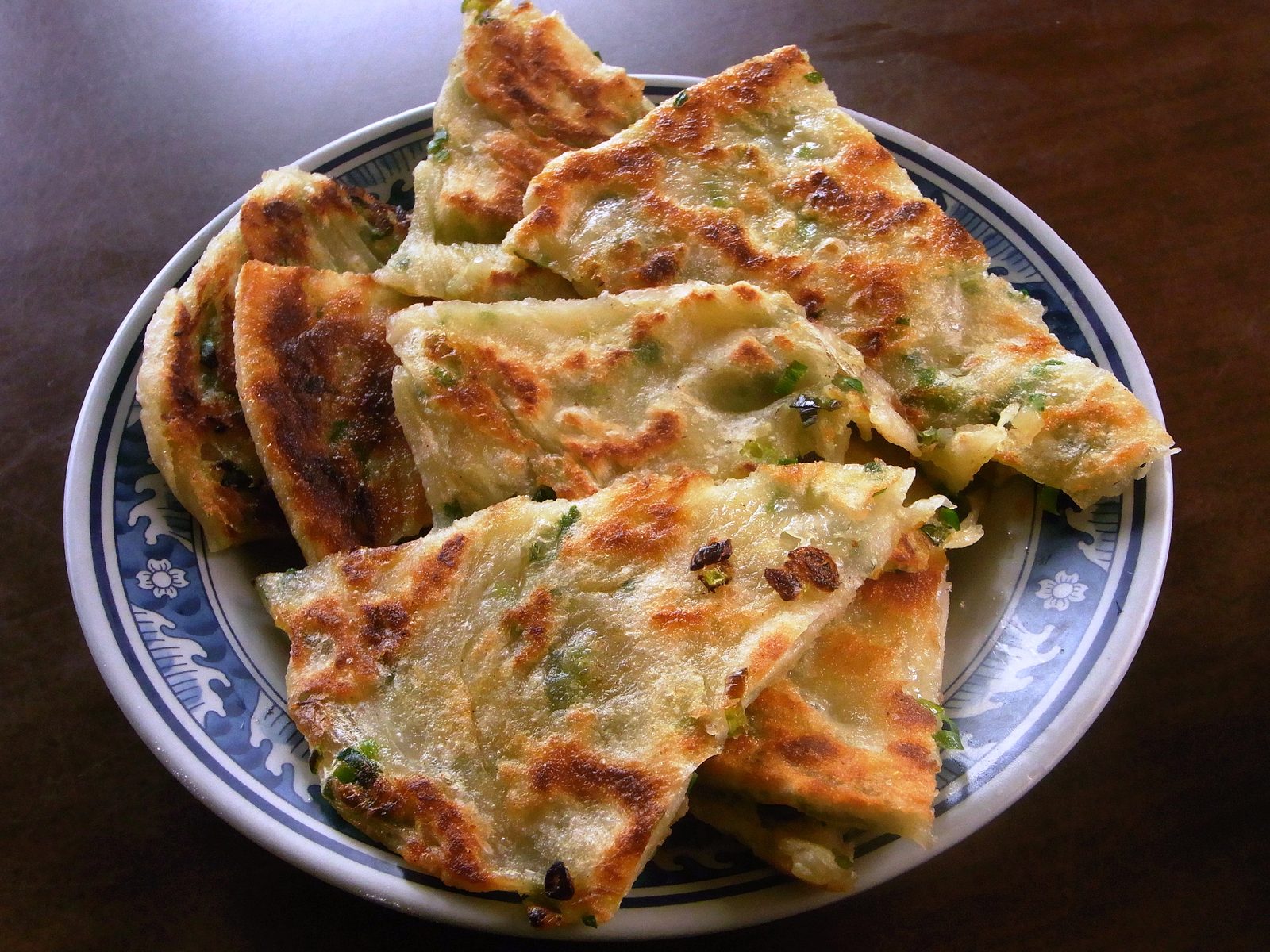
Dough laminated multiple times with scallion oil and lard — in the manner of a rough puff pastry, but savoury and without the butter. Each layer visible when you tear it open; spring onion embedded through. Pressed onto a dry iron griddle until both sides are emphatically golden, the outer surface shatters, the inner layers remain soft and fragrant. The smell carries a long way — you often find the vendor before you see it. Vendors start at 5.30 am and reliably sell out by mid-morning. Eaten warm, pulled apart and dipped into a bowl of warm doujiang, it explains something essential about this city.
The Shanghai version of tofu pudding is not the sweet dessert familiar elsewhere. Hot soy milk is poured into a bowl with a small measure of black vinegar; the acid curdles the protein on contact into soft, silken white flakes — somewhere between a custard and a lightly set egg-drop. Fried shallots, dried shrimp, pickled mustard greens, and a thread of chilli oil go on top. The bowl arrives hot, steaming faintly, smelling of the sea and the kitchen at once. It is ¥6–12 and wholly, specifically Shanghainese. The liquid version (咸豆浆 xián dòujiāng) is looser and more pourable; the set version (豆腐花 dòufuhuā) holds its shape in the spoon.
Shanghai is a large city. Knowing which neighbourhood does what saves you a lot of walking.
The most food-dense stretch of the city for famous-name breakfast. Yang's Dumplings and Jia Jia Tang Bao are a five-minute walk apart, with da bing carts and scallion noodle shops filling the lanes between them. The buzz before 8.30 am is particularly good. Come here if you want celebrated spots in a single morning pass.
Shanghai's oldest food culture is here. Nanxiang Mantou Dian has been making dumplings at this address since 1900. Scallion pancake vendors, stewed snacks and small street stalls line the lanes around the garden. Crowded on weekends but the history is real and the morning light is good before the tourist crowd arrives.
Before the neighbourhood turns cosmopolitan and expensive, its back streets are home to some of the city's best local breakfast stalls — ci fan tuan carts, da bing vendors, tofu pudding spots. Open from 5.30 am. If you arrive before 8 am, you will be the only person not commuting to work. Everything costs under ¥15.
Better known as a dinner neighbourhood, Xuhui still has local breakfast vendors tucked into the lanes around its primary schools and wet markets. Fewer stalls than Jing'an, but the neighbourhood itself — tree-lined streets, Art Deco buildings — makes the early morning walk worthwhile. Good for a slower, unrushed morning.
The best stalls open between 5.30 and 6.00 am. Many sell out by 9.30 am. The sweet spot is 7.00–8.30 am: everything is freshly made, still hot and properly stocked. After 10.00 am you will find reduced choice, closed carts and the beginning of the tourist queue at the famous spots.
Most street stalls are cashless — and not credit-card cashless: they mean Alipay or WeChat Pay only. Some will accept RMB notes, but fewer every year. Download Alipay before your trip and link a Visa or Mastercard via the international visitor mode (this now works smoothly for tourists). Read the full walkthrough in our China payments guide. Chain spots like Yonghe King accept cards and have English screens.
No English menus, no bilingual staff, and that is fine. Point at what the person ahead of you ordered. Point at the finished item on display. Show the Chinese characters from this page on your phone and nod. Shanghai street vendors have been serving confused foreigners for decades. They will work it out.
Ci fan tuan is designed to be eaten while walking. Shengjian bao are handed to you in a wax-paper bag and eaten standing outside the shop. Da bing is folded in your hand. If you are waiting for a table with a tablecloth and a napkin, you have gone to the wrong place. The pavement and the street are the dining room.
Shengjian bao lose their crackling base within minutes of leaving the wok. You tiao go rubbery when cold. Scallion pancake loses its flakiness fast. The whole tradition of Shanghai breakfast is structured around eating things as they come off the heat. Ordering, walking back to your hotel and eating at the desk is the wrong call.