Imagine a mosque with no dome and no minaret — instead, a carved wooden gateway, curved tiled roofs, a pagoda-shaped prayer-call tower and quiet rock gardens. This is one of the oldest and largest mosques in China, hidden down a narrow lane in Xi'an's Muslim Quarter.
You push through a street packed with skewer stalls and the smell of grilling lamb, turn down a narrow lane you almost miss, and suddenly the noise drops away. In front of you is an old wall, a carved wooden gateway and a garden so still you can hear the leaves. It is not a Buddhist temple or a Taoist shrine — it is the Great Mosque of Xi'an (西安大清真寺), and if nobody told you, you would walk straight past assuming it was just another Chinese temple.
The mosque was first founded in 742 AD under the Tang dynasty, when Xi'an — then called Chang'an — was the eastern terminus of the Silk Road and home to Persian and Arab merchants. Over the centuries it was expanded under the Ming and Qing dynasties into what is now the largest and most complete Chinese-style mosque in the country, and one of the oldest still in active use.
What makes it remarkable is how little of it matches what most of us picture when we think "mosque." There is no dome and no soaring minaret. Instead, Chinese architects built it in their own language: a long east-west axis divided into four linked courtyards, with stone gateways, wooden pavilions, sweeping tiled roofs and rock gardens. The elements that make it a place of Islamic worship — the mihrab pointing towards Mecca, the Quranic inscriptions — are folded seamlessly into that Chinese form. It is not just a pretty site; it is a thousand-year lesson in two cultures living side by side.
And the most important thing to know before you go: this is not a museum. It is an active place of worship for the Hui community — Chinese-speaking Muslims who have lived in this neighbourhood for generations — and people still come here to pray five times a day. Walk quietly, dress modestly, and treat it as the sacred space it is.
Follow the long axis from east to west, one courtyard at a time, and you will understand why this feels more like a temple than a mosque.
1
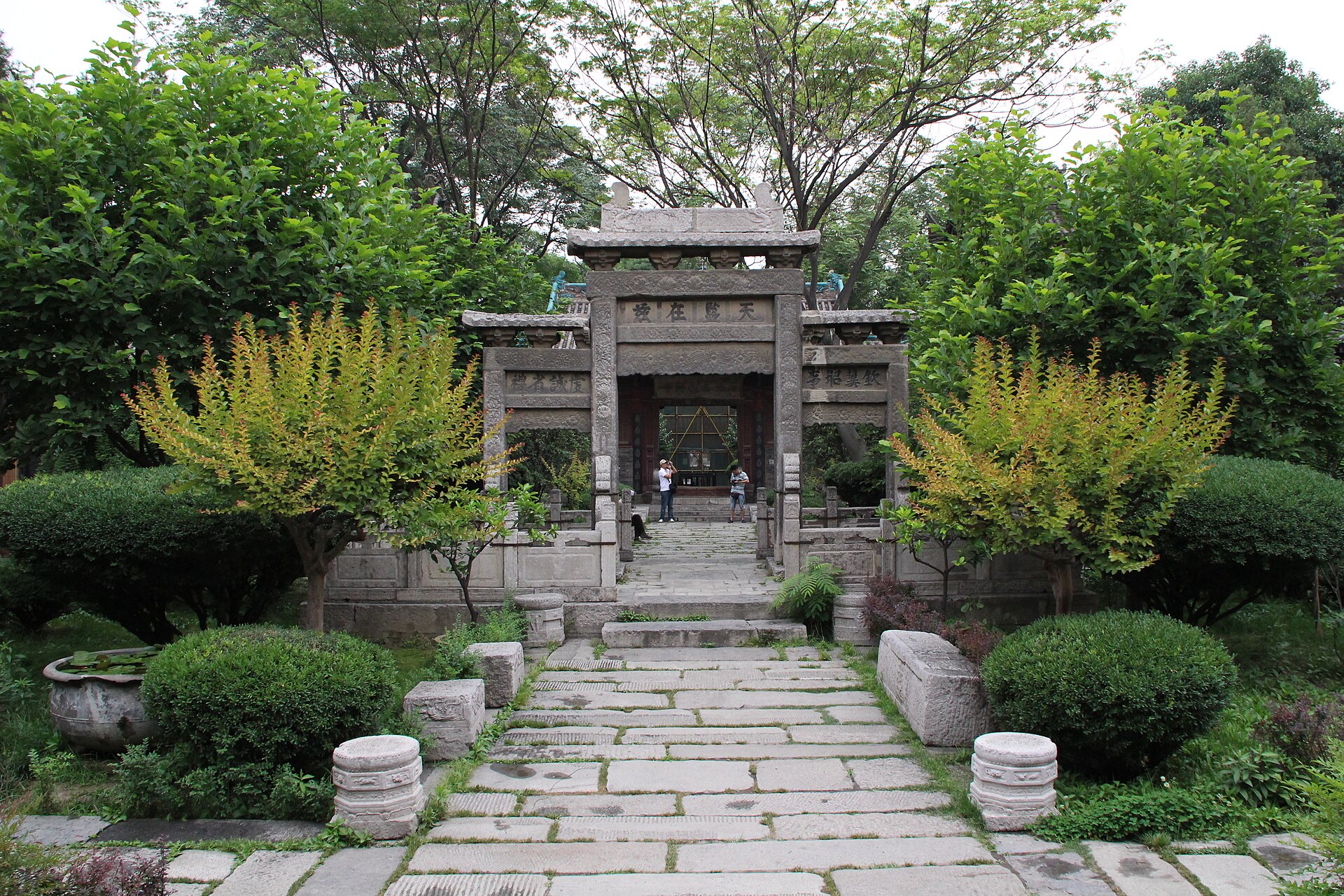
Step through the entrance and the first courtyard greets you with a large, centuries-old wooden archway carved end to end with Chinese motifs. Without the Arabic script set into it, you would never guess this was a mosque. The courtyard is paved in stone, edged with trees and anchored by a screen wall (照壁) of the kind found in Chinese palaces. From the very first step, the building announces that it has chosen to speak Chinese throughout.
This is the moment that stops people in their tracks. In mosques worldwide, the minaret is usually a tall, slender tower used to call the faithful to prayer. Here in Xi'an, that role is played by a three-storey wooden pavilion in the shape of a Chinese pagoda called Shengxin Lou, standing at the centre of the second courtyard. Its tiered, upturned roofs look exactly like a pavilion in an imperial garden, yet it does the same job as any minaret — dressed entirely in Chinese clothes. It is the whole mosque summed up in a single building.
In the third courtyard stands the small Phoenix Pavilion (Fenghuang Ting), named because its three-part roof, seen head-on, resembles a phoenix spreading its wings to take flight — a beautifully detailed piece of Chinese carpentry. Around it sit several ancient stone steles, some inscribed with poems and imperial edicts in the hand of renowned calligraphers. A number of them carry both Chinese and Arabic script on the same stone: tangible evidence of two worlds meeting in one place.
At the far western end of the axis is the main Prayer Hall, a large timber building that can hold around 1,000 worshippers. Its western wall, facing Mecca, carries a mihrab decorated with intricate patterning and Arabic calligraphy. This is the spiritual heart of the complex, and it is reserved for Muslims. Non-Muslim visitors are welcome to admire it from outside but do not go in — and during prayer times in particular, keep your distance and stay especially quiet.
5
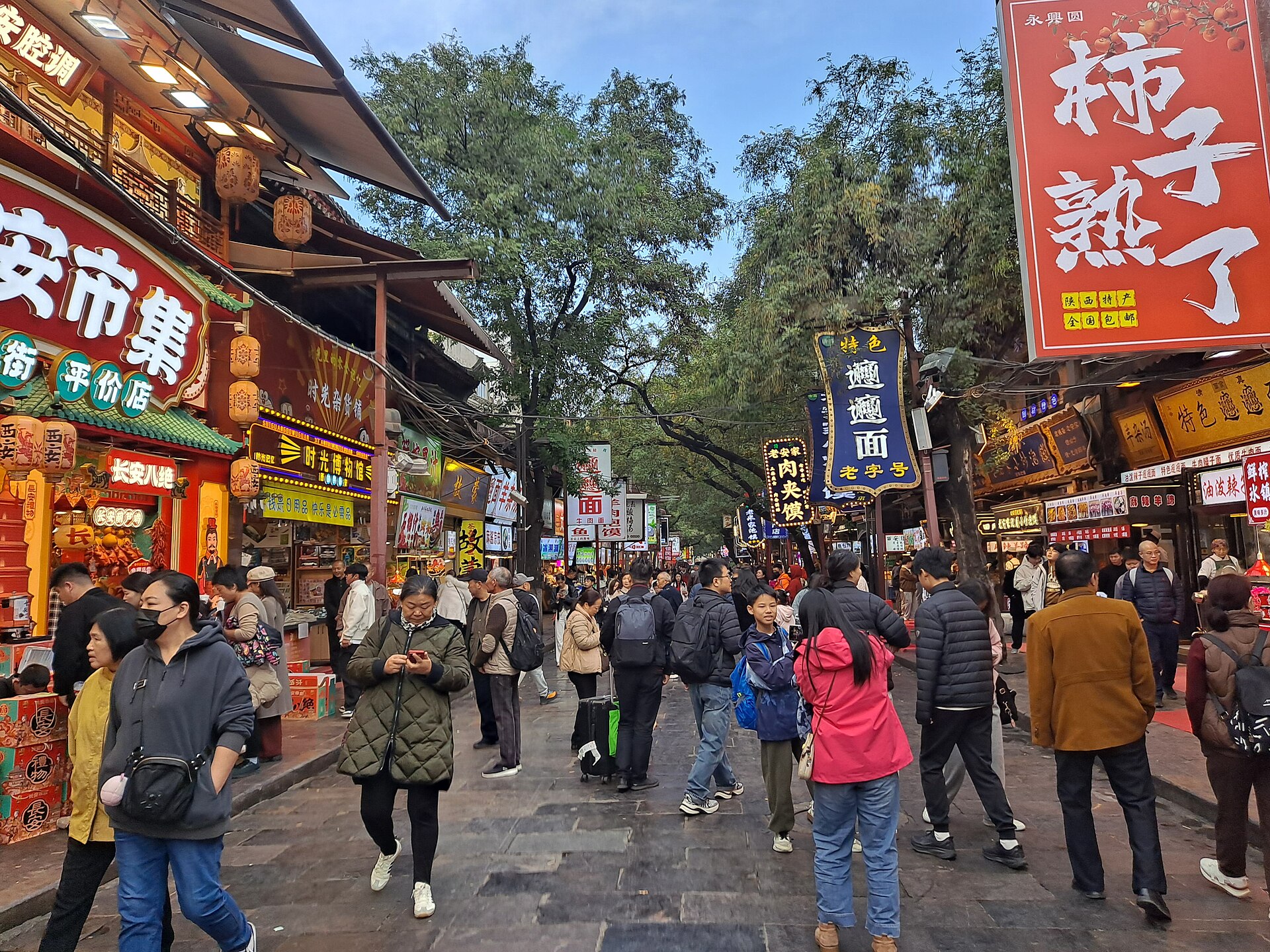
The mosque does not stand alone — it is the spiritual centre of the surrounding Muslim Quarter. Walk out of Huajue Lane and you are on Beiyuanmen street, lined with grilled-lamb skewers, roujiamo (the Chinese "burger"), biang biang noodles and Hui sweets. The smell and noise are the complete opposite of the calm inside the mosque. The trick is to visit the mosque first, in the quieter late morning, then come out and eat your way through the quarter.
Everything you actually need to know, in one place.
The Great Mosque sits in the centre of the old city, in the Muslim Quarter behind the Drum Tower. It is one of the easiest sights in Xi'an to reach, because it is right beside all the major landmarks.
Get off at Zhonglou (钟楼), leave by Exit B and walk west for about 6 minutes to reach the Drum Tower. From there, turn northwest into Huajue Lane for another 5 minutes to the mosque. This is the most convenient approach, and it takes you straight through the street-food quarter.
If you have just finished cycling the City Wall at the South Gate (Yongningmen), take Line 2 north two stops to Zhonglou and walk into the Muslim Quarter. This works perfectly if you ride the wall in the morning and visit the mosque late morning.
Take Line 3 from Dayanta, change to Line 2 and ride to Zhonglou — about 35 minutes in total. This suits a plan that starts at the pagoda in the morning and moves into the old city for the middle of the day, then covers the Bell and Drum Towers, the mosque and the Muslim Quarter in one loop.
If you have a free half-day: climb the Bell and Drum Towers for the old-city views (9–10.30 am), walk into Huajue Lane to the Great Mosque while it is still quiet, then come out to eat roujiamo and grilled lamb in the Muslim Quarter. Done by 1–2 pm, with the City Wall or the Shaanxi History Museum easy to add next.
The Bell and Drum Tower area and the streets inside the City Wall are very close to the mosque and the Muslim Quarter. Staying here puts every landmark within walking distance. Here are the hotels we have reviewed: