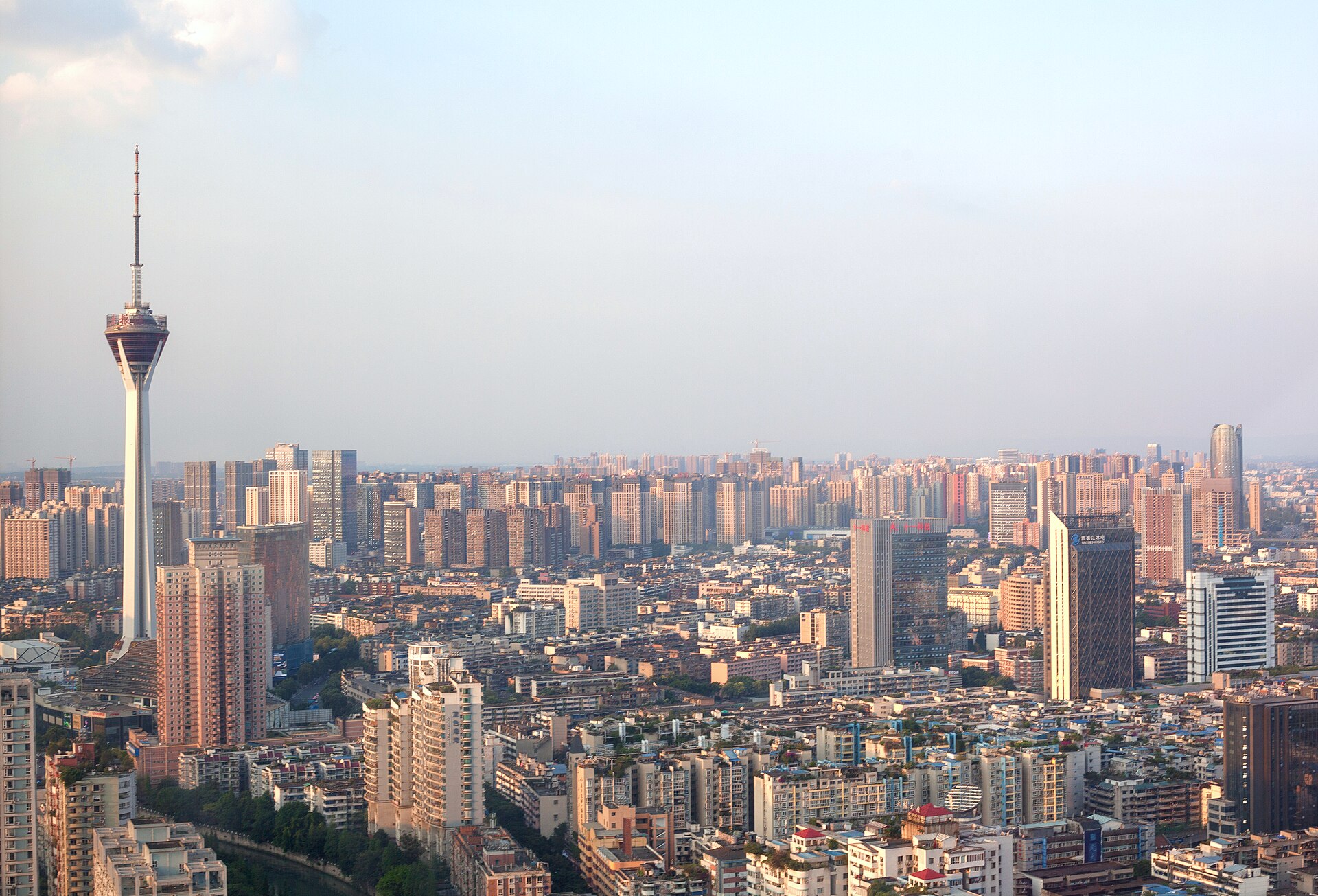
Home Chengdu China Chengdu Hotels About
Home  ›  Asia  ›  China  ›  Chengdu  ›  Getting Around
🚇 Chengdu Transport Guide · 2026

Getting Around Chengdu
Metro, DiDi, Bikes & More

Line 3 takes you straight to the pandas, Lines 2 and 3 drop you at Chunxi Road, most fares are just ¥2–4, and a shared bike unlocks for ¥1.5 — getting around this laid-back city is easier than you'd expect once you know the system.

Before you go

A city you can cross almost entirely by metro

Chengdu is famous for tea, hotpot and pandas — and travellers are often surprised to find it also has one of the largest metro systems in China. More than 15 lines and over 300 stations are open today, reaching both airports, Chunxi Road, the old Kuanzhai alleys, and the Panda Base in the north of the city. You can get to almost every sight underground.

Two things make this easy for visitors. Signs and ticket machines are bilingual, and since 28 July 2025 the metro gates accept foreign Visa and Mastercard contactless cards directly — no app required — or you can scan an Alipay QR code instead. Two things to know first: every entrance has a bag X-ray check (always, not just at rush hour), and last trains run before 23:00 on most lines, with the exact time varying by line and direction.

This guide covers every way to move around Chengdu: the cheap, fast metro, metered taxis, DiDi for when you have luggage, and the ¥1.5 shared bikes that suit this city perfectly — Chengdu is flat from edge to edge, with wide cycle lanes. A little preparation, and the transport side of your trip simply works.

The main event

The Metro — fast, cheap, bilingual

Your first choice for nearly every journey. Clean trains, English signage throughout, and fares of ¥2–8 on almost every ride.

Hours are roughly 06:00–23:00 (a few lines, such as Line 7 and Line 18, run to around 23:30), though this varies by line and terminus — check the last-train time in the app if you're out late. Fares are distance-based, starting at ¥2 for the first 4 km and rising by ¥1 every few kilometres after that. Most central rides cost ¥2–4; even the long run out to Tianfu Airport tops out around ¥8–9.
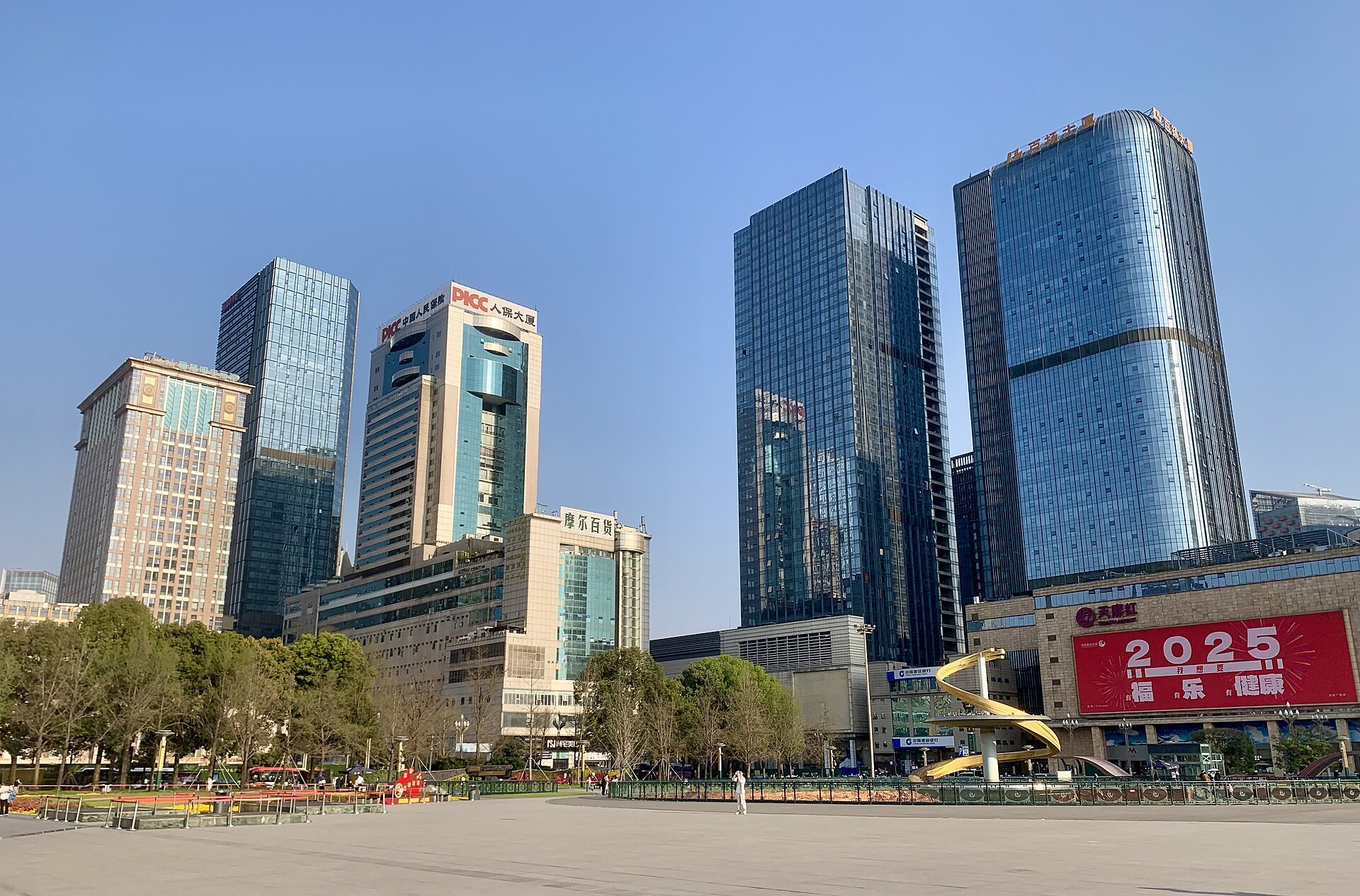
Tianfu Square, central Chengdu — the Mao statue, fountains and city skyline, the interchange of metro Lines 1 and 2
Tianfu Square is the Line 1 / Line 2 interchange at the heart of the city — nearly every central journey passes through here. Memorise this station and getting around gets a lot simpler.
Key lines

Routes visitors use most

Line Route Key stops
Line 1 (N–S spine) North ↔ south through the centre Tianfu Square · Chengdu South Railway Station · Financial City
Line 2 Northwest ↔ east Chunxi Road · Tianfu Square · People's Park (near Kuanzhai) · Chengdu East Station
Line 3 Southwest ↔ northeast Chunxi Road · Panda Avenue (熊猫大道 · shuttle to Panda Base)
Line 4 East ↔ west Kuanzhai Alley (宽窄巷子 · Exit B, 60 m walk) · Du Fu Thatched Cottage
Line 7 (loop line) Loops the inner city Chengdu East Station · Chengdu South Station · connects almost every line
Line 10 Centre ↔ Shuangliu Airport (CTU) Shuangliu Airport T1/T2 · Taipingyuan (change for Line 3)
Line 18 City ↔ Tianfu Airport (TFU) Chengdu South Station · Tianfu Airport T1/T2 (express, ~50 min)
Two-airport tip: Chengdu has two airports. Most flights from Thailand now land at Tianfu (TFU), far to the southeast — take Line 18 into the city. The older, closer Shuangliu (CTU) is served by Line 10. Check which one your ticket lands at, because the two sit on opposite sides of the city. Full details in the Chengdu airport transfer guide.
Paying for the metro

Four ways to pay — pick what suits you

📱
Alipay / WeChat QR

Easiest for visitors. Open Alipay or WeChat, search "Chengdu Metro", open the QR code, scan at the gate. No token needed. Set this up at home.

💳
Foreign card

Since 28 July 2025 the gates take Visa, Mastercard and Amex contactless directly on every line. No app to link — handy the moment you land.

🎫
Single-journey token

Buy from machines inside every station. English menus, takes notes and coins. A good fallback if Alipay isn't set up yet.

🟢
Tianfu Tong card

The rechargeable 天府通 card gives a 10% fare discount and also works on buses. Buy and top up at Hongqi supermarkets or station service points.

Honest summary: Alipay is worth setting up even if the metro is your only reason, because it also handles taxis, DiDi, shared bikes, restaurants and nearly every shop in the city. Read the step-by-step setup in the Alipay & WeChat Pay guide before you travel.

Other options

Taxis, DiDi, Bikes and Buses

🚕
Metered Taxis
出租车 · always on the meter

Chengdu taxis are metered, with a flag-fall of around ¥8 for the first 3 km during the day (06:00–22:00), then roughly ¥1.9 per km. Fares run a little higher in traffic, and a surcharge applies late at night. Even so, taxis here are cheap compared with bigger Chinese cities.

The one practical tip that makes taxis actually work: have your destination written in Chinese characters. Most drivers speak little or no English. Use Amap or Google Translate to prepare it in advance and screenshot it, or have your hotel write it on a small card.

Sample fares: Chunxi Road → Kuanzhai Alley ~¥12–18 · Tianfu Airport → city centre ~¥120–150
Payment: Cash · Alipay · WeChat Pay (varies by car)
Note: No surge pricing — the meter is the meter
🚗
DiDi — China's ride-hail
滴滴出行 · English app, Alipay payment

DiDi is the dominant ride-hail app in China. Switch it to English under Me > Settings > Language > English, type your destination in English, and the app locates it and shows a fare before you confirm. Payment links directly to Alipay, and a built-in chat auto-translates messages between you and the driver. It's the right call when the metro has closed, when you have luggage, or for routes that need several line changes.

In Chengdu, DiDi is genuinely good value: the per-kilometre rate is low, and it's easier than flagging a taxi in the rain — and Chengdu does get a lot of light drizzle. Keep it installed as your backup whenever you travel off the metro lines.

Set language: Me > Settings > General > Language > English
Payment: Link Alipay in-app; it charges automatically at trip end
Tip: Download and set it up before you travel
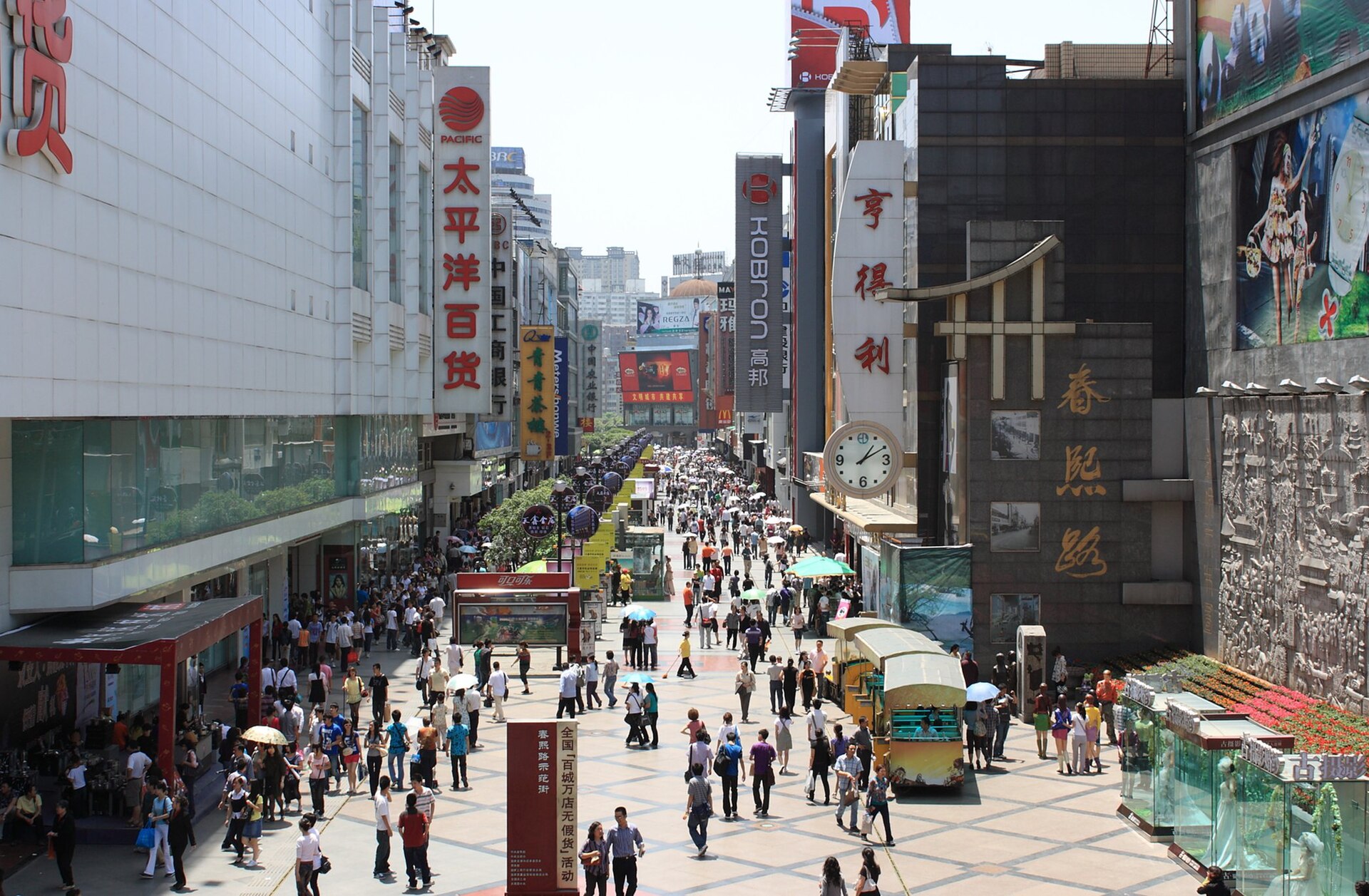
Chunxi Road, Chengdu — the busy downtown shopping street, served by metro Lines 2 and 3 Meituan / Hello bikes
Shared Bikes
共享单车 · ¥1.5, unlock by QR

Chengdu is flat from edge to edge with wide cycle lanes, and Meituan (yellow) and Hello (blue) shared bikes sit on almost every corner. Scan the QR code on the bike through Alipay or WeChat to unlock it; fares start around ¥1.5 per 30 minutes.

The photo on this card is Chunxi Road, the downtown shopping district — cycling around the old quarters and along the Jin River nearby is a real pleasure. Return the bike inside a designated zone (shown in the app) or you may be charged extra.

Fare: from ~¥1.5 per 30 min · pay via Alipay/WeChat
Unlock: Scan the bike's QR code in the Alipay or WeChat app
Note: Return inside a designated parking zone — check the app
🚌
Public Buses
公交车 · comprehensive but Chinese-only

Chengdu's bus network covers hundreds of routes, reaching corners of the city the metro does not. Fare is typically ¥2 per journey, payable by Tianfu Tong card, Alipay/WeChat, or cash (exact change into the box).

Honest note: bus stop signs and route numbers are almost entirely in Chinese, with no English timetables. For most visitors, the metro is a much easier first choice. Buses make sense for specific spots off the metro, and work well combined with Amap (Gaode), which has accurate Chengdu bus data in its transit directions.

Fare: typically ¥2 per trip
Payment: Tianfu Tong · Alipay/WeChat · exact cash into the box
Navigation: Use Amap (Gaode) for bus route planning
Your first ride

Your first journey, step by step

The first time can look fiddly, but it's genuinely simple. Say you're riding from a hotel near Chunxi Road out to Panda Avenue station to see the pandas. Here's exactly how it goes.

1. Find the entrance — Look for the red "M" Chengdu Metro logo. Entrances usually have several mouths (A, B, C, D); any will do. Ride the escalator down to the concourse.

2. Clear the X-ray check — Place every bag on the belt through the scanner and walk through the detector. This adds about 1–2 minutes (no large liquids or sharp objects).

3. Through the fare gate — Open Alipay, search "Chengdu Metro", bring up the QR code and hold it to the reader on the gate (the glowing circle). The gate opens — or tap your Visa/Mastercard on the same spot instead.

4. Find the right platform — Follow the signs by terminus name. On Line 3, the direction towards "Chengdu Institute of Public Administration" is the one heading to Panda Avenue. Every sign carries pinyin and English.

5. Exit (scan or tap again) — Chinese systems charge by distance, so you scan or tap both on entry and on exit. Keep your QR ready as you leave, then follow the numbered Exit signs to the one closest to your destination.

Etiquette worth knowing: stand on the right on escalators · let passengers off before you board (there are floor markings at the doors) · the yellow/red seats are reserved for the elderly, pregnant women and children · no eating on board · and loud phone conversations are normal in China, so don't be startled.
Navigation

Which map app actually works in Chengdu

This matters more than people expect. Google Maps' public transit data for mainland China is unreliable — even with a VPN, route guidance for the metro and buses is frequently wrong or simply absent. Two apps give accurate, real-time transit directions without any workaround:

🗺️
Amap (Gaode / 高德地图)
The app most Chinese residents use

Amap has accurate, live data for every metro line, bus route and intercity train in China. You can search destinations in English; the transit planner gives step-by-step directions, including which exit to use. Download it from the App Store or Play Store before you arrive — no VPN required to use it.

Tip: Download before departure. Some app stores in China require a VPN to access.
🍎
Apple Maps
iPhone users already have this

Apple Maps in China uses Amap's data as its backend, which means its transit directions for the Chengdu metro are accurate. If you have an iPhone, this is the path of least resistance — no extra app, no VPN. Some locals also use Baidu Maps, though Baidu is Chinese-only.

Android note: Google Maps transit doesn't work well in China — install Amap instead.

If you want LINE, Instagram, Gmail or full Google Maps while in China, you'll need a VPN installed and tested before you fly — most VPN websites are blocked once you're inside the country. See the full breakdown at the China internet, VPN and eSIM guide.

Chengdu city skyline at dusk — towers and streets lit up in the evening
Planning a late evening out? Check the last-train time for your return line before you leave — and keep DiDi ready to cover the gap when the metro closes.
Do these first

Two things to set up before you board your flight

If there are two preparations that make a difference, they're these. First, open Alipay, link your Visa or Mastercard through the international mode, and find the "Chengdu Metro" feature in the app before you leave home. Second, download Amap and DiDi while you're still in Thailand, because installing them later in China can run into app-store and VPN issues. Land in Chengdu with these ready and you can travel straight away.

One more practical note: avoid peak hours if you can — 08:00–09:00 and 17:30–19:00 on the main inner-city lines (especially Lines 1, 2 and 7) are genuinely crowded. If you're arriving from the airport or heading there with luggage, shifting your journey outside these windows makes the whole thing easier.

First-timer note: Heading to the Panda Base? Go as early as you can (it opens 07:30). Take Line 3 to Panda Avenue (熊猫大道), leave by Exit A, and transfer to shuttle bus 408 — by late morning the pandas tend to retreat to the shade. Full details in the Chengdu Panda Base guide and the Chengdu first-timer guide.
Common questions

FAQ · Getting around Chengdu

What are the Chengdu metro hours?
Most lines run from around 06:00 to 23:00; a few (such as Line 7 and Line 18) run until around 23:30. Last trains from terminus stations leave well before closing, and hours vary by line and direction. Check the last-train time for your return line in Amap or on the signs inside the station before a late night out.
How do I pay for the Chengdu metro?
Several ways: (1) Alipay or WeChat — search "Chengdu Metro", open the QR code, scan at the gate; easiest for tourists. (2) The rechargeable Tianfu Tong card (天府通), which gives a 10% fare discount and also works on buses. (3) Since 28 July 2025, the gates accept foreign Visa, Mastercard and Amex contactless cards directly. (4) A single-journey token from the station machines, which have English menus. Full setup instructions in the Alipay & WeChat Pay guide.
How do I get to the Chengdu Panda Base by metro?
Take Metro Line 3 to Panda Avenue station (熊猫大道 / Xiongmao Dadao), leave by Exit A, and transfer to shuttle bus 408 to the South Gate of the Panda Base. The whole trip from the city centre takes roughly 40–60 minutes including the transfer. Go as early as you can — the pandas are awake and feeding in the morning and tend to retreat to shade by late morning. Full details in the Chengdu Panda Base guide.
Does DiDi work in English? Do I need to speak Chinese?
DiDi has an English interface (set it under Me > Settings > Language > English). You can type a destination in English, the app locates it and shows a fare before you confirm, and payment links directly to Alipay. A built-in chat auto-translates messages between you and the driver, so you do not need to speak Chinese.
Can I use Google Maps in Chengdu?
Google Maps can display a basic map (with a VPN) but its transit data for mainland China is unreliable or absent. Use Amap (Gaode / 高德地图) or Apple Maps instead — both use accurate, real-time data for the metro and buses, and neither requires a VPN. Some locals also use Baidu Maps, though it is Chinese-only.
How do shared bikes work in Chengdu, and what do they cost?
Chengdu is covered with Meituan (yellow) and Hello (blue) shared bikes parked on almost every street corner. Scan the QR code on the bike through Alipay or WeChat to unlock it; fares start around ¥1.5 per 30 minutes. Return the bike inside a designated parking zone (shown in the app) to avoid extra charges. The city is flat with wide bike lanes, so cycling along the river or through the old quarters is genuinely pleasant.