Home Xi'an China Xi'an Hotels About
Home  ›  Asia  ›  China  ›  Xi'an  ›  Roujiamo
🇨🇳 Xi'an Food · Shaanxi · 2026

Roujiamo (肉夹馍)
the Chinese hamburger, centuries older than the Western one

Slow-braised meat, chopped fine and packed into a crisp baked bun — one bite and the savory-sweet juices run into the crackle of the bread. This is Xi'an's everyday street classic, the one locals queue for every morning.

Before you eat

Roujiamo — meat in bread, made in Xi'an for 2,000 years

Walk into a Xi'an side street early in the morning and you will catch it before you see it: the smell of a braising pot that has been simmering overnight. That is the signal a roujiamo (肉夹馍, ròu jiā mó) shop is open. The name translates as "meat sandwiched in bread," and Westerners like to call it the "Chinese hamburger" — some even bill it as "the world's oldest hamburger." It does look like chopped meat in a round bun, but it predates the Western burger by centuries. This style of braised-meat sandwich has been eaten in Shaanxi province for more than 2,000 years.

A great roujiamo comes down to two parts that both have to be right — the meat and the bun. The meat is lazhirou (腊汁肉), pork belly simmered slowly in soy sauce, Shaoxing wine, sugar and more than a dozen spices: star anise, cassia, cumin, black cardamom and dried orange peel among them. The best old shops braise it in an "aged broth" (老汤) that they top up but never throw away, sometimes carried over for years — the older the pot, the deeper the flavour. Once the pork is falling-apart tender, it is chopped, fat and lean together, and packed into a hot bun. That bun is the baijimo (白吉馍), a round flatbread of semi-leavened dough baked until the outside is crisp and golden in a ring while the inside stays soft.

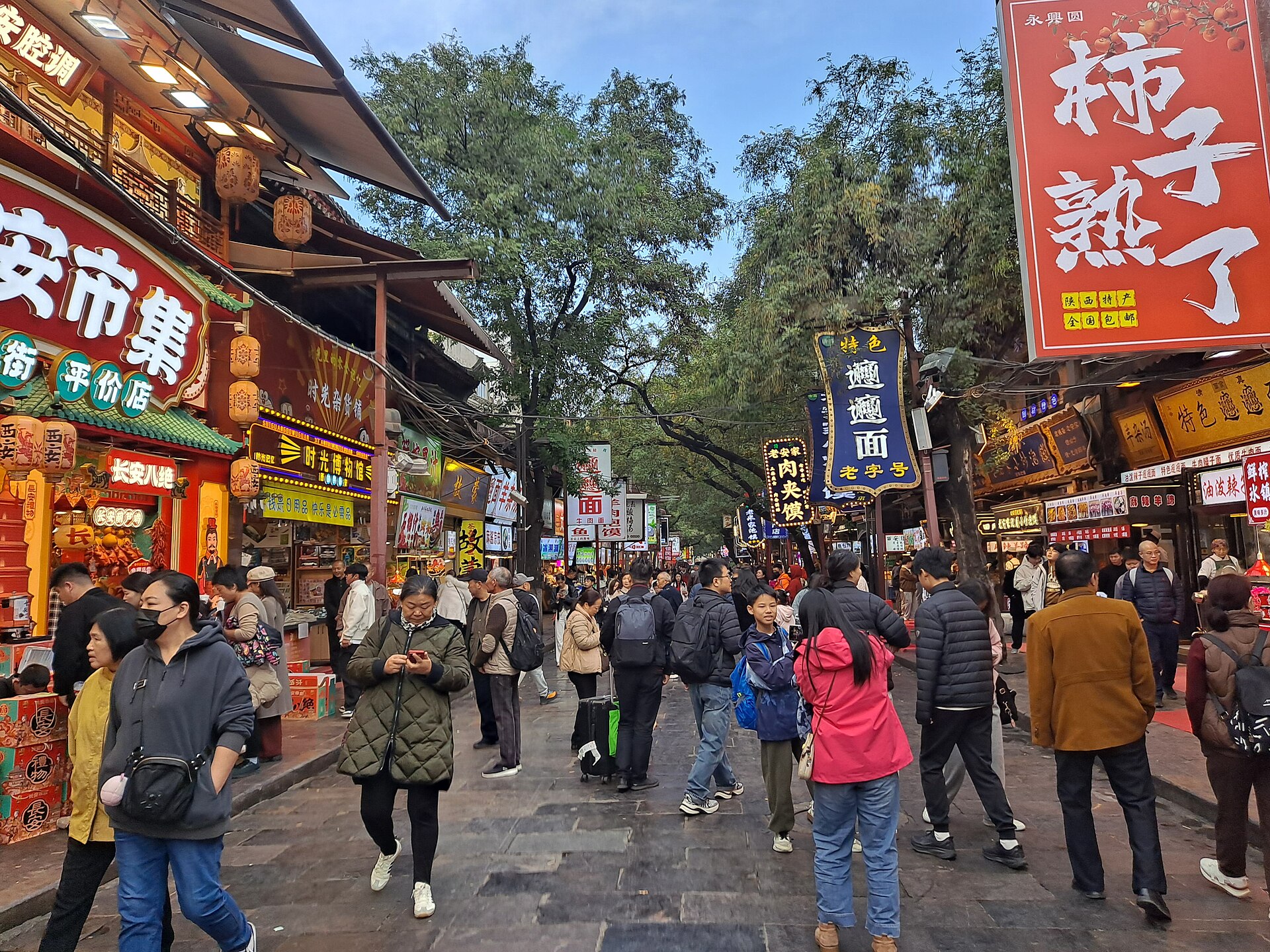
What many visitors don't realise is that roujiamo comes in two lineages — the Shaanxi pork version, and the halal beef-or-lamb version of the Hui Muslim community that has lived in the heart of Xi'an for over a thousand years. In the Muslim Quarter (回民街) there is no pork at all; stalls use salt-braised beef or lamb (腊牛肉), some dusted with cumin and chilli until it turns fragrant and bold. Both use the same baijimo bun, but they taste like different worlds. This page walks you through both — how each is made, how they differ, where to find them, and how to order like a local.
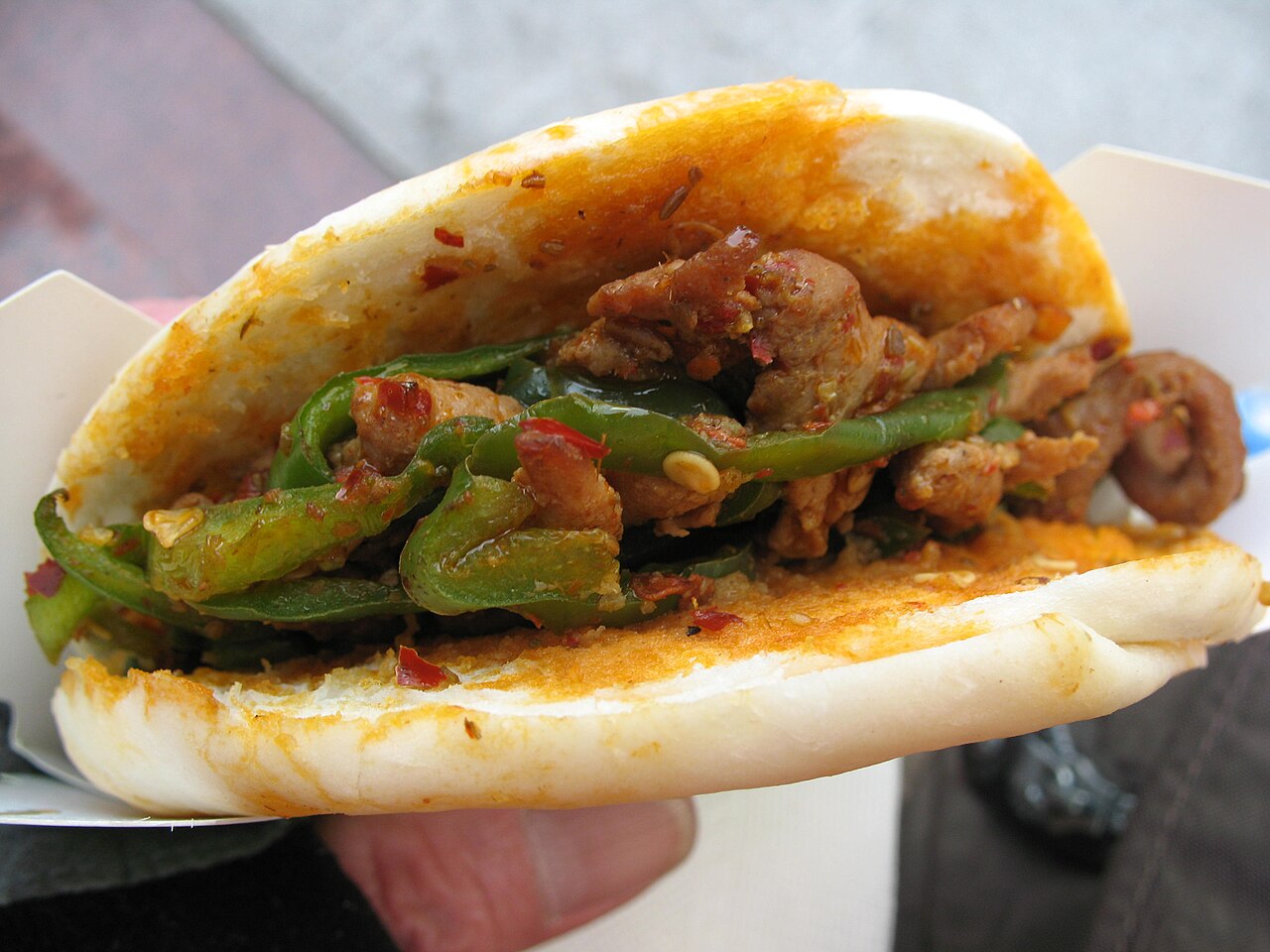
A roujiamo: crisp golden baijimo bun stuffed with chopped braised meat and stir-fried green pepper, held in hand
The classic roujiamo — a baijimo bun baked until the edge crisps into a ring, packed with chopped meat soaked in braising juices and stir-fried green pepper. One bite: crisp outside, soft inside, juices running.
Two lineages of roujiamo

Shaanxi pork vs halal Muslim-Quarter meat

The same sandwich tells the city's story two ways — eat both to understand Xi'an properly.

Roujiamo filling: chopped braised meat with green pepper and peanuts in a dark glossy sauce on a round bun 1
The pork version (腊汁肉夹馍)
là zhī ròu jiā mó · slow-braised pork belly — the Shaanxi original

This is what most people outside Xi'an picture first. Pork belly braised in lazhirou — the overnight soy-and-spice master stock — until the skin turns soft and the fat melts to a jelly, then chopped fat-and-lean together and packed into a hot bun. The flavour is rounded, deeply savory-sweet, rich but not heavy. Locals order it feishou (a fat-and-lean mix) because that melting fat is the whole point. Some shops add stir-fried green pepper for a fresh note.

Where: Fan Ji (樊记 · 53 Zhubashi St · near the Bell Tower) · roujiamo shops citywide outside the Muslim Quarter
Price: ¥8–13 / piece (about ฿40–65)
How to order: feishou (肥瘦 fat-and-lean) or chunshou (纯瘦 lean only)
Xi'an's Muslim Quarter 回民街 food street crowded with halal food stalls and red shop signs 2
The halal meat version (腊牛肉夹馍)
là niú ròu jiā mó · salt-braised beef / lamb — halal, Muslim Quarter

In the Hui Muslim quarter there is no pork, so stalls use beef or lamb braised in a salty spiced stock called laniurou. The meat is firmer than pork and has more chew; some stalls finish it with toasted cumin and ground chilli for that punchy Hui flavour that meat-lovers fall for. If you want lamb, look for the sign 腊羊肉; if you prefer beef, look for 腊牛肉 — both are delicious in different ways.

Where: stalls in the Muslim Quarter back lanes — Dapiyuan (大皮院) · Sajinqiao (洒金桥) · Lao Sun Jia (老孙家)
Price: ¥10–18 / piece (about ฿50–90)
Note: entirely halal — no pork, no alcohol
Good to know: these two lineages mirror Xi'an itself — the old imperial capital where the Silk Road began. The Hui Muslim community settled here more than a thousand years ago, so halal cooking and Han Shaanxi cooking have always lived side by side. Pork roujiamo and beef-or-lamb roujiamo are the same idea, told from two sides of the same city.
Behind one piece

How roujiamo is made

1 · The braised meat — the older the pot, the better

Pork belly is cut into big chunks, blanched clean, then simmered in a braising liquid built from light and dark soy, caramelised sugar, Shaoxing wine, star anise, cassia, bay leaf, cumin, white pepper, black cardamom and dried orange peel. It cooks low and slow for an hour or more until the meat pulls apart easily. The most famous old shops keep a "master stock" (老汤) going, topping it up with fresh spices and never tipping it out, sometimes for years or decades. The older the pot, the deeper the aroma — which is exactly why a brand-new shop struggles to match a legend's flavour.

2 · The baijimo bun — iron ring, tiger back, flower heart

Semi-leavened wheat dough is shaped into a round, flat disc and baked in a clay oven or griddled on an iron pan until the outside crisps to a golden ring and the inside stays soft and fluffy. Locals describe the ideal bun in one phrase: "iron ring, tiger back, chrysanthemum heart" (铁圈虎背菊花心) — a crisp ring around the edge, a cracked tiger-stripe top, and a flower pattern on the base. The crumb has to be dense enough to hold the braising juices without falling apart.

3 · The assembly — chopped fresh, stuffed hot, eaten now

When you order, the cook lifts the braised meat onto a board and chops it fresh — fat and lean together — adds a spoonful of braising liquid, and sometimes stir-fried green pepper or chilli. Then a hot bun straight off the oven is split open and stuffed, and it lands in your hand while the bread is still crisp. Bite it immediately: the moment the crisp crust, soft crumb and juicy meat all meet is the whole magic of roujiamo. Leave it ten minutes and the bun softens and the flavour shifts.

Where to eat

The roujiamo spots Xi'an locals queue for

Legendary shops and the places locals actually eat — all confirmed open as of 2026.

1
Fan Ji (樊记腊汁肉夹馍)
The legendary pork roujiamo · Zhubashi St · decades old

If you want your first pork roujiamo in Xi'an, this is the name locals reach for first. An old shop in the Zhubashi lane near the Bell Tower that people have queued at for decades — tender, juicy braised meat, a deep aroma from the master stock, a bun crisped just right. It recently expanded with a second floor for more comfortable seating, and the price is gentle for the reputation. Lunchtime gets busy, so go a little earlier to skip the longest wait.

Address: 53 Zhubashi St (竹笆市), Beilin District · about a 5-minute walk from the Bell Tower
Price: ¥8–13/piece (about ฿40–65) · pay by WeChat Pay / Alipay · small carts take cash in yuan
2
Muslim Quarter back lanes — Dapiyuan & Sajinqiao
Halal beef / lamb · 大皮院 / 洒金桥 · where locals actually eat

The main drag of the Muslim Quarter (回民街) is busy with tourists and a little pricier, but turn into the back lanes — Dapiyuan (大皮院) or Sajinqiao (洒金桥) — and you'll find the stalls locals rely on. The salt-braised beef and lamb roujiamo here is firm and full-flavoured, dusted with fragrant cumin and chilli, and some of these stalls have been running long enough to be neighbourhood institutions. Everything is halal: look for the sign 腊牛肉 (beef) or 腊羊肉 (lamb) and point to order.

Address: Dapiyuan / Sajinqiao lanes · west side of the Muslim Quarter, near the Great Mosque
Price: ¥10–18/piece (about ฿50–90) · pay by WeChat Pay / Alipay
3
Lao Sun Jia (老孙家)
Halal institution since 1898 · known for salt-braised beef

One of the oldest Muslim restaurants in Xi'an, open since 1898. It is best known for yangrou paomo (羊肉泡馍, mutton soup with torn flatbread), but it also serves a well-regarded salt-braised beef roujiamo (腊牛肉夹馍). It's a good choice if you'd rather sit in an air-conditioned room with proper seating than eat standing at a stall. It has moved into a shopping centre near the Muslim Quarter in recent years, so check the latest location on Amap or Dianping before you go.

Address: near the Muslim Quarter / Dong Dajie · check the current location on Amap (高德) or Dianping (大众点评)
Price: roujiamo ¥12–18 · paomo ¥32–45/bowl · cards and WeChat/Alipay accepted
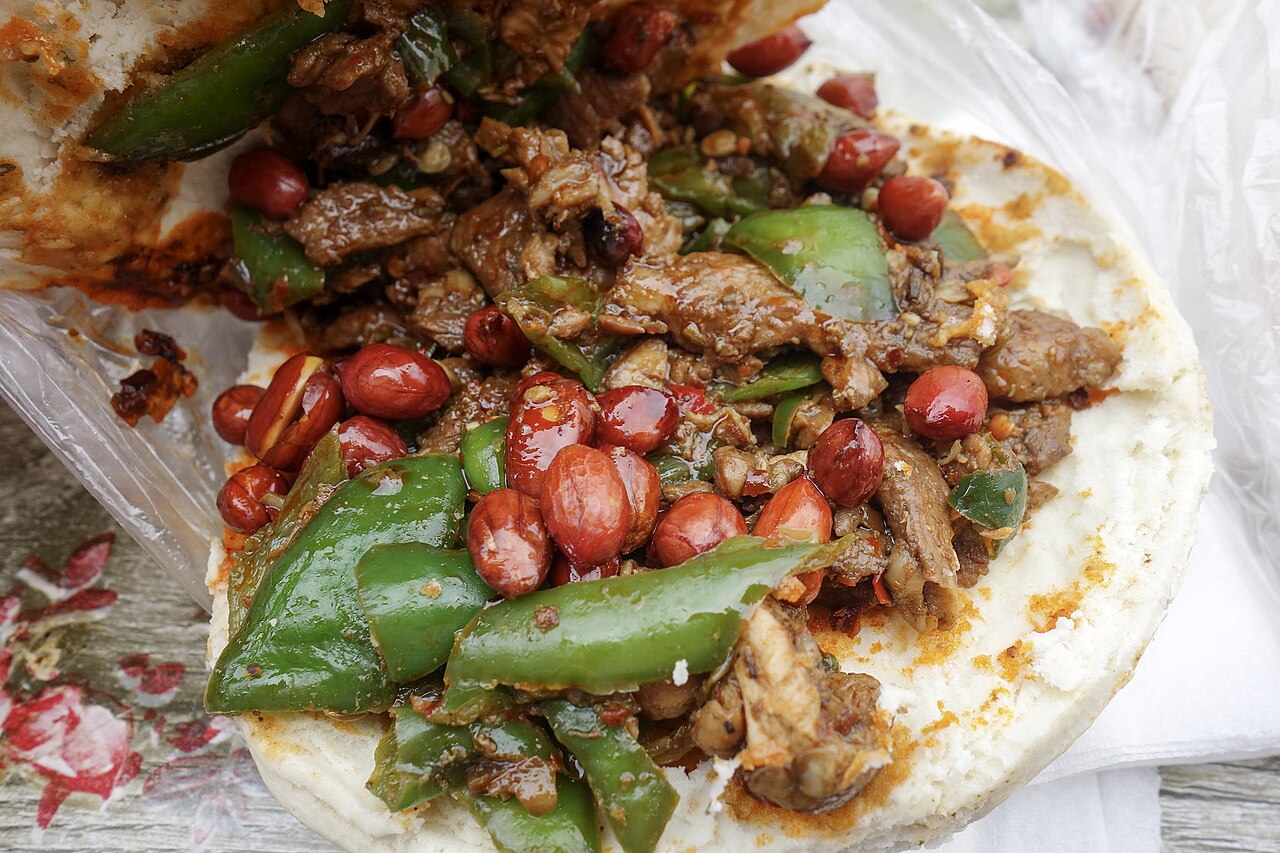
Roujiamo filling close-up: chopped braised meat tossed in dark sauce with green pepper and peanuts on a baijimo bun
The chopped meat tossed in dark braising sauce with green pepper and peanuts — the way the melting fat works through the meat is exactly why locals order it "feishou," fat and lean together.
Eat like a local

How to order it like a local

Choose your filling — fat-and-lean or lean only

For the pork version, most locals ask for feishou (肥瘦), a mix of fat and lean, because the melting fat is what keeps each bite juicy and fragrant. If you'd rather skip the fat, ask for chunshou (纯瘦), lean only, though it comes out a touch drier. Some shops ask whether you want stir-fried green pepper (青椒) added — answer as you like. For the halal meat version, look for the sign 腊牛肉 (beef) or 腊羊肉 (lamb) and point; some stalls let you choose spicy or not.

Eat it immediately — the hot bun is the star

Roujiamo is meant to be eaten while the bun is still hot and crisp. Don't let it sit and don't take it back to the hotel — give it ten minutes and the bread softens and the juices soak through, and you lose that crisp-outside, soft-inside moment. Watch for dripping braising liquid too: bite from the top or tilt it slightly and you'll stay tidy. From a stall, it usually comes wrapped in paper or a bag so you can eat it on the move.

Build the full set

Locals rarely eat roujiamo on its own. The usual pairing is a bowl of liangpi (凉皮) — cold skin noodles tossed in a garlicky, vinegary, chilli sauce that cuts the richness perfectly — or a bowl of hulatang (胡辣汤), a thick, peppery soup eaten in the morning. Together that's a proper Shaanxi breakfast, all for a handful of yuan and an easy way to fill up on a budget.

Frequently asked

FAQ · what to know before you eat roujiamo

What is roujiamo (肉夹馍) and why is it called the Chinese hamburger?
Roujiamo (肉夹馍) literally means "meat sandwiched in bread" — chopped meat packed into a round baked bun called baijimo (白吉馍). Westerners nicknamed it the "Chinese hamburger," and it is sometimes billed as "the world's oldest hamburger" because it looks like meat in a round bun. In reality it predates the Western burger by centuries: this style of braised-meat sandwich has been eaten in Shaanxi province for more than 2,000 years.
What is the difference between the pork and the lamb versions?
The classic Xi'an version uses pork belly braised in a master stock called lazhirou (腊汁肉) — slow-cooked in soy, spices and an aged broth the best shops have kept going for years, giving a deep, rounded, sweet-savory flavour. In the Muslim Quarter (回民街) everything is halal, so there is no pork: stalls use salt-braised beef or lamb known as laniurou (腊牛肉) instead, often dusted with cumin and chilli for a punchier, spicier taste. Both versions use the same baked baijimo bun.
Where should I eat roujiamo in Xi'an?
For the pork version, the legendary spot is Fan Ji (樊记腊汁肉夹馍) at No. 53 Zhubashi Street near the Bell Tower — an old-timer locals have queued at for decades, around ¥8–13 a piece. For the halal beef or lamb version, the Muslim Quarter is the place: the back lanes such as Dapiyuan (大皮院) and Sajinqiao (洒金桥) are where locals actually eat. Lao Sun Jia (老孙家), open since 1898, is also known for its salt-braised beef sandwich (腊牛肉夹馍).
How much does roujiamo cost?
Roujiamo is cheap street food, roughly ¥8–18 (about ฿40–90) per piece depending on the shop and filling. The pork version at Fan Ji runs around ¥8–13; the halal beef or lamb version in the Muslim Quarter is roughly ¥10–18. Most stalls take WeChat Pay or Alipay via QR code, and smaller carts still accept cash in yuan.
What makes the baijimo (白吉馍) bun different from ordinary bread?
Baijimo (白吉馍) is a round, flat wheat bun made from semi-leavened dough, baked in an oven or griddled on an iron pan until the outside is crisp and golden in a ring while the inside stays soft and fluffy. The crumb is dense enough to soak up the braising juices without going soggy. Locals describe a good one as "iron ring, tiger back, chrysanthemum heart" (铁圈虎背菊花心) — a crisp ring around the edge, a cracked tiger-stripe top, and a flower pattern on the base.
How do I order roujiamo like a local?
For the pork version, locals usually ask for feishou (肥瘦) — a mix of fat and lean — because the melting fat keeps it juicy. If you want lean only, ask for chunshou (纯瘦). Some shops ask whether you want stir-fried green pepper (青椒) added; say yes or no as you like. Eat it immediately while the bun is hot and crisp — don't let it sit, or the bread softens and the juices soak through. Locals pair it with a bowl of cold liangpi (凉皮) skin noodles or a bowl of spicy hulatang (胡辣汤) soup.
Klook · Food Tour

Xi'an Food Tour — the right stalls, with someone who knows

A guided Xi'an food crawl through the Muslim Quarter and its back lanes, tasting roujiamo, biangbiang noodles, cumin lamb skewers and paomo — real bites, no language worries.

See Xi'an food tours on Klook →
Wherebest is a Klook affiliate partner — we may earn a commission when you book through our links, at no extra cost to you.