Home Beijing China Beijing Food Guide About
Home  ›  Asia  ›  China  ›  Beijing  ›  Breakfast Guide
Beijing Breakfast Guide · 2026

Breakfast in Beijing
From a hot jianbing to the famously sour douzhi

Before the city fully wakes, Beijingers are queuing at the jianbing griddle, sipping hot soy milk from a paper cup, and carrying a steamer-fresh bun into the hutong. A morning that costs under ¥15 — and tells you more about this city than any hotel buffet ever will.

Why wake up early

The real Beijing is awake at six

Most visitors to Beijing sleep in, eat a hotel buffet, and leave thinking the local food is "just roast duck." That is a genuine loss. The best meal of the Beijing day happens on the pavements of the hutong, in the small shops below the Drum Tower — not in a buffet hall.

Beijing's breakfast culture runs centuries deep. It stretches from jianbing — the hot egg crêpe that sizzles on round street-side griddles — to douzhi, a fermented mung-bean drink so sour that locals adore it and, let's be honest, most visitors flinch on the first sip. In between sit chao gan, a garlicky offal gravy eaten with steamed buns; the easy, universal pairing of soy milk and a you tiao dough stick; and sweet morning bites like tang huo shao. A thorough morning, sampling several of them, rarely costs more than ¥25–40 per person (~฿125–200).

This guide covers Beijing breakfast honestly, dish by dish — what is worth trying, what takes nerve, how to eat it, where to find it, what time to go, and what to carry with you.

The king of breakfast

煎饼 — Jianbing, the crêpe Beijingers eat every morning

If you only have room for one thing, make it this — ¥8–12 (~฿40–60), made fresh in front of you, hot and crisp.
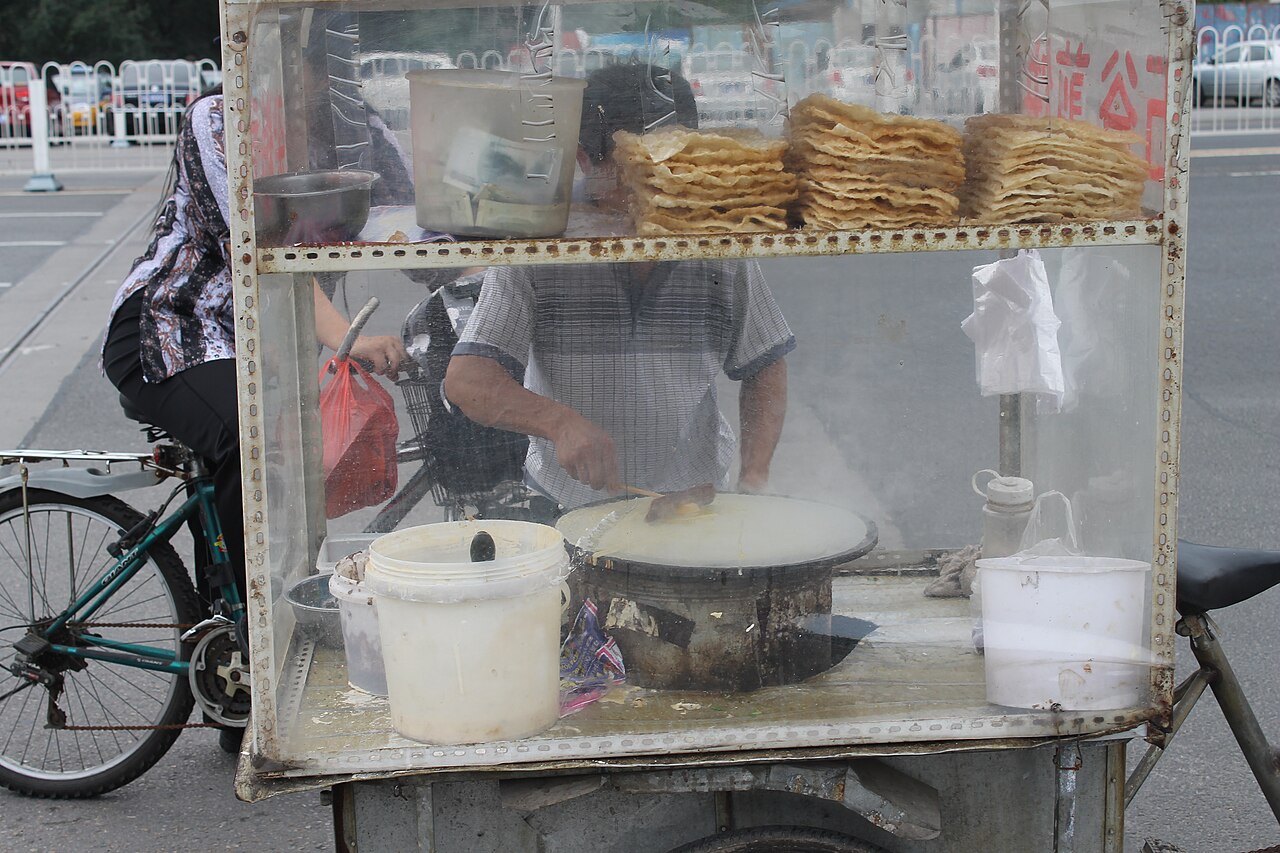
How a jianbing comes together — watch before you order

Batter spread thin on a hot round griddle, an egg cracked over the top, scallions and coriander scattered on, sweet bean and chilli sauce brushed across, a sheet of crisp fried cracker (báocuì) laid in, then the whole thing folded into a hot parcel and handed over — every step done in front of you in about ninety seconds. Jianbing carts open before seven and do their briskest trade as the city heads to work.

🫓
Batter & egg
面糊 + 鸡蛋

Spread on the griddle, egg on top

🌿
Scallion & herbs
葱花 + 香菜

Fresh, with sweet bean sauce

🍘
Crisp cracker
薄脆 · Báocuì

The crunch — non-negotiable

🌯
Folded hot
折叠 · to go

Eat on the move, no mess

A Beijing street jianbing cart, a vendor spreading crêpe batter on a hot round griddle with stacks of crispy crackers (baocui) on the shelf above 1
Jianbing (Jiānbing)
煎饼 · the savoury egg crêpe, king of street breakfast

This is the breakfast Beijingers eat most. A thin grain-flour batter is spread on a hot round griddle, an egg cracked and smoothed over it, scallions and coriander scattered on, then sweet bean and chilli sauce brushed across. The heart of the dish goes in last: a sheet of crisp fried cracker (báocuì) for the crunch, before the whole thing is folded into a hot parcel. One bite gives you soft, crisp and savoury all at once. Jianbing is said to go back more than 2,000 years. Every cart tastes a little different — try a few and you'll find your favourite.

How to eat: eat it the second you get it — the cracker softens if it sits
Price: ¥8–12 each (~฿40–60)
Find it: street carts in every hotel district and at hutong entrances — open 6.30–10.00 am
🥤2
⚠️ Truly old-Beijing · an acquired taste
Douzhi + Jiaoquan (Dòuzhī)
豆汁 + 焦圈 · fermented mung bean + crisp dough ring

Let's be straight up front: douzhi is not something most people enjoy on the first try. It is a drink fermented from the lees of mung beans — the by-product of making mung-bean noodles — grey-green in colour, sour, and carrying a strong fermented smell all its own. Older Beijingers grew up with it and love it so deeply they call it the taste of home, but most visitors wrinkle their nose at the first sip. It is served hot with jiaoquan, a crisp fried dough ring shaped like a bracelet, plus shredded pickles. Dunk the jiaoquan in and bite. If you want to really understand Beijing, this is the one to be brave about once — but there is no shame in passing if it is not for you.

Find it: Huguosi Snacks (护国寺小吃) · old snack shops in the hutong
Price: ¥5–10 per set (~฿25–50)
Tip: sip slowly with the pickles — the aroma hits hardest first, then eases
🥣3
⚠️ Offal · for the brave
Chao Gan + Baozi (Chǎogān)
炒肝 + 包子 · garlicky liver-and-intestine gravy

Chao gan is a classic Beijing breakfast that locals have queued for over a century — a bowl of glossy, starchy brown gravy holding thin slices of pork liver and intestine, seasoned with so much garlic it is wonderfully pungent. Beijingers don't use a spoon; they lift the bowl and sip around the rim, with a hot steamed bun on the side. The legendary spot is Yao Ji Chao Gan (姚记炒肝) below the Drum Tower, open from six in the morning and packed every day — some mornings you'll wait for a table. Be warned, this is offal: heaven if you love that sort of thing, easy to skip if you don't.
Where: Yao Ji Chao Gan (姚记炒肝 · 311 Gulou Dongdajie, below the Drum Tower) · open 6.00 am–10.30 pm
Price: chao gan ¥10–14 a bowl + baozi ¥4–6 (~฿70–100 together)
How to eat: lift the bowl and sip the rim, no spoon — alternate with the bun
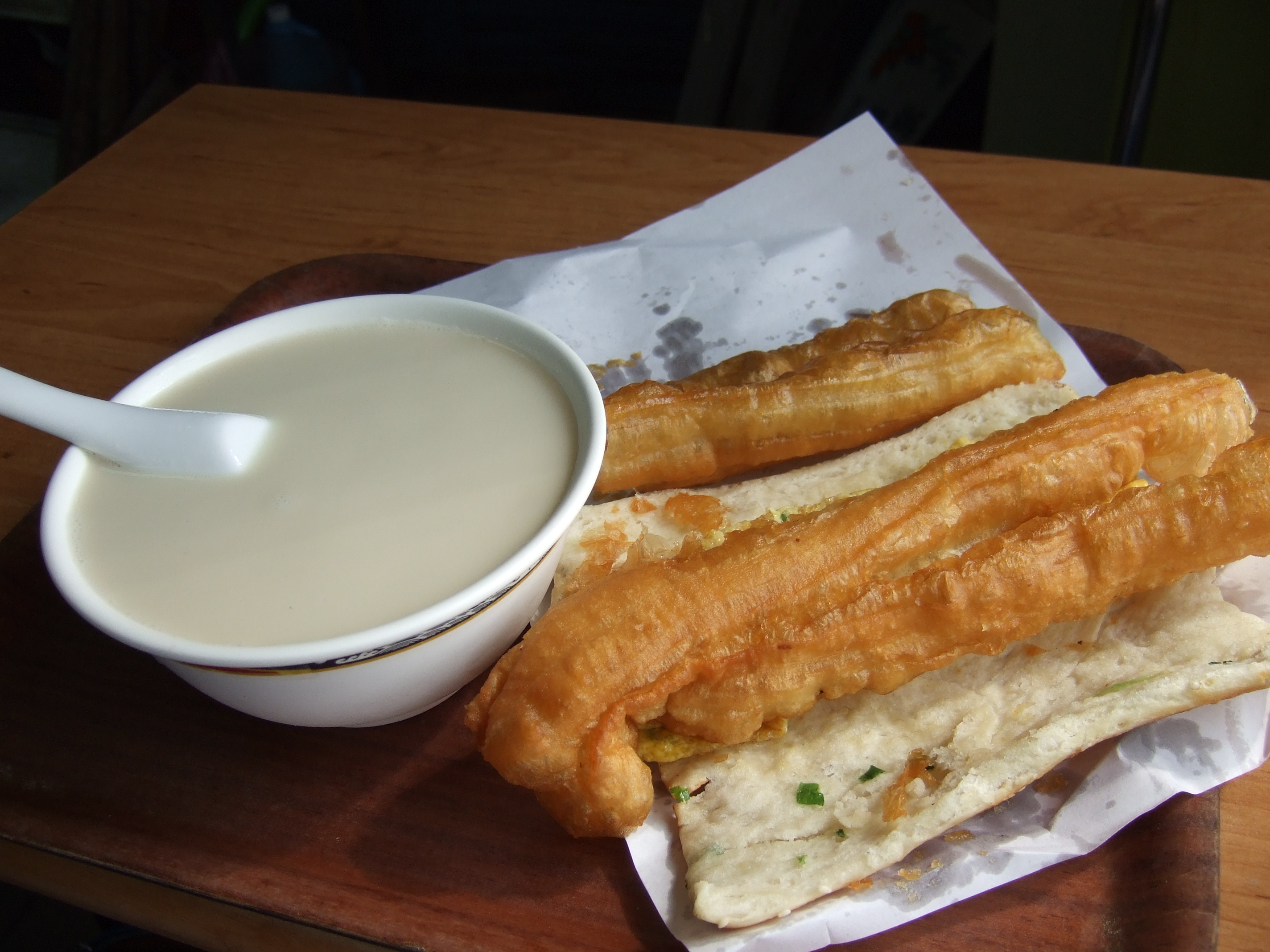
A bowl of hot soy milk (doujiang) with a spoon, served beside golden deep-fried dough sticks (you tiao) and a scallion pancake on a wooden tray 4
Doujiang + You Tiao (Dòujiāng + Yóutiáo)
豆浆 + 油条 · soy milk + fried dough stick

The safest, most familiar pairing on this list. You tiao is a deep-fried dough stick — a Chinese cruller, hollow and soft inside, crisp and golden outside. Doujiang is fresh, hot soy milk, served either sweet or savoury. The traditional move is to tear off pieces of you tiao, dunk them in the doujiang, and bite — the dough soaks up just enough soy milk to change its texture entirely. If you're new to Chinese breakfast and not yet ready for the bold stuff, start here. It's tasty, filling, and there's nothing on the plate to fear.
How to eat: tear the you tiao and dunk it in the doujiang · pick sweet or savoury
Price: ¥5–10 per set (~฿25–50)
Find it: stalls and breakfast shops citywide · the Yonghe King chain
Old-Beijing morning classics

The traditional bowls still worth seeking out — following old Beijing

These four are the heritage of Beijing breakfast. Some are ancient; some you have to track down to a specific shop.

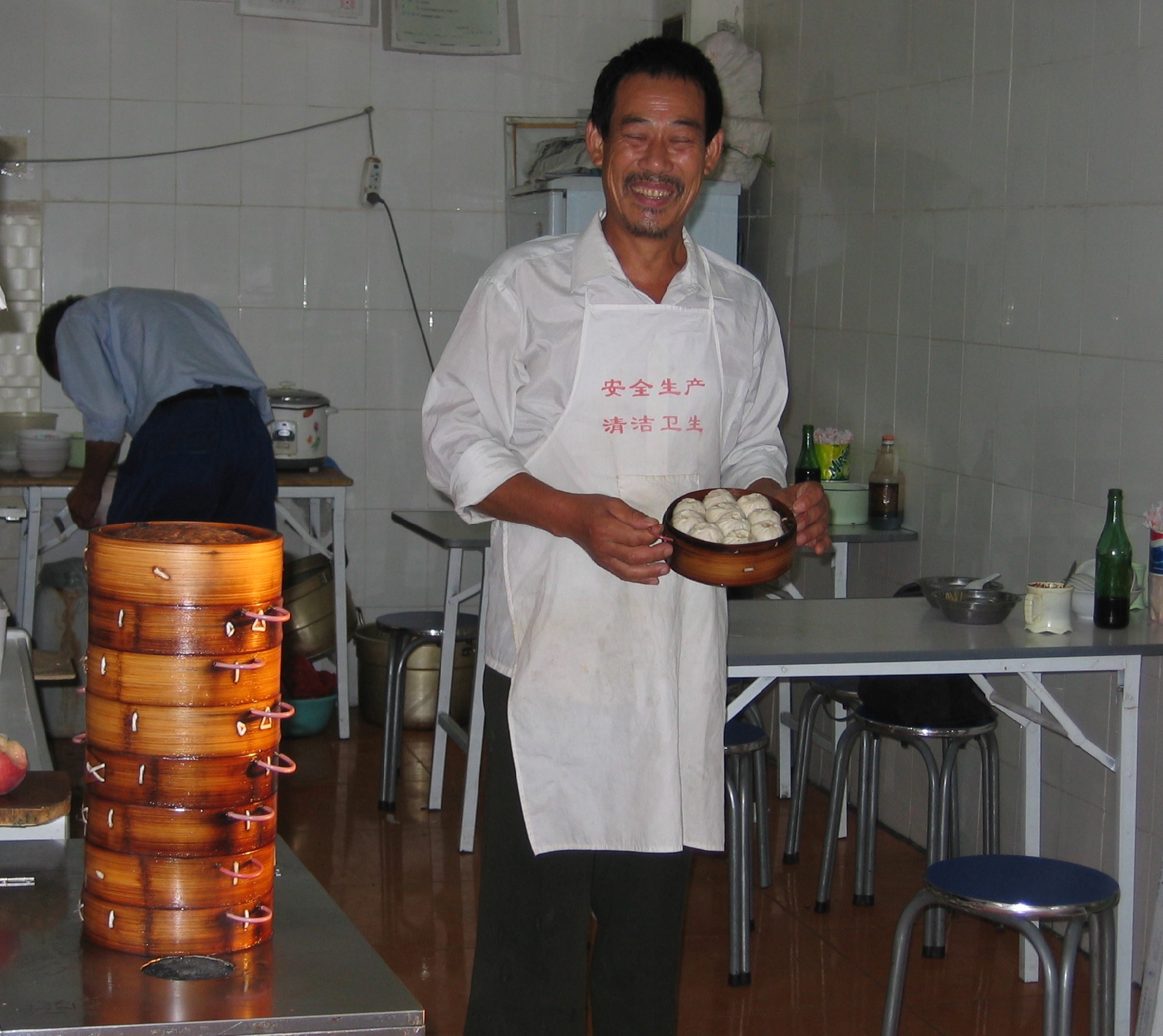
A vendor in a Beijing baozi shop holding a bowl of freshly steamed buns, with tall stacked bamboo steamers beside him in a white-tiled kitchen 5
Baozi (Bāozi)
包子 · hot steamed buns, pork and scallion

Baozi are the steamed buns eaten for breakfast across China, but Beijing has a legendary house: Qingfeng Baozi (庆丰包子铺), going since 1948, which became famous nationwide overnight after the Chinese president stopped in for a meal in 2013. The classic filling is pork and scallion, but you'll also find pork belly, vegetarian, shrimp, and beef-and-carrot. Prices are tiny — three buns for ¥4. Steamer-fresh and pillowy, eaten with a cup of soy milk or congee, baozi are filling, gentle and entirely uncomplicated — they suit everyone.

Where: Qingfeng Baozi (庆丰包子铺 · branches citywide, English screens)
Price: 3 buns ¥4–6 (~฿20–30) · a full meal around ¥10–15
Pair with: warm doujiang or a bowl of rice congee (粥)
🥣6
Miancha (Miànchá)
面茶 · millet paste topped with sesame

Miancha is an old-Beijing morning bowl many people don't even know exists — a millet-flour porridge cooked until thick and smooth like polenta, then crowned with a heavy layer of rich sesame paste and a dusting of toasted sesame seeds. Millet is China's oldest grain, sustaining the north through dynasty after dynasty. There's an etiquette to eating it: you never stir it, and you never use a spoon. Instead you lift the bowl and sip from the rim, rotating it so the plain porridge and the sesame paste reach your mouth together. The result is nutty, rich and warming on a cold morning. Traditional spots like Huguosi Snacks, and small hutong shops around Jiaodaokou, serve it until they sell out and then close.

Find it: Huguosi Snacks (护国寺小吃) · miancha shops in the Gulou/Jiaodaokou hutong
Price: ¥6–10 a bowl (~฿30–50)
How to eat: lift the bowl and sip the rim, no stirring, no spoon — that's the real way
🍲7
⚠️ Offal · rich and bold
Luzhu Huoshao (Lǔzhǔ Huǒshāo)
卤煮火烧 · stewed offal with flatbread

Luzhu huoshao carries a palace backstory. It began as a Qing-dynasty court dish made with pork belly, but ordinary people couldn't afford pork belly, so they used pork lung, intestine, liver and other offal instead — simmered in a deep, spiced braising broth with pieces of huoshao (a dense Chinese flatbread) and fried tofu. It arrives as a hot bowl, bold and aromatic with spice and a little heat. Some Beijingers eat it as a heavy breakfast on a cold day. This is genuinely local, street-rooted food — not a delicate one — but if you like offal and big flavours, don't miss it.

Find it: old luzhu shops in the hutong · old-Beijing street-food spots
Price: ¥15–25 a bowl (~฿75–125)
Note: bold and all-offal — for fans of strong flavours, not for first-timers
🍩8
Tang Huo Shao (Táng Huǒshāo)
糖火烧 · baked sesame-and-sugar cake

To finish, a sweet morning bite. Tang huo shao is a round baked cake filled with brown sugar and black sesame paste, baked until the outside is golden and the inside stays chewy and sweet, with the smell of toasted sesame rising off it. It's an old Beijing pastry with more than 300 years of history, and it pairs nicely with hot soy milk or tea in the morning. If you've worked through a lot of savoury bowls and want to end on something sweet, this one is light and easy to carry — find it at Huguosi Snacks and traditional Beijing snack shops.

Find it: Huguosi Snacks (护国寺小吃) · old Beijing pastry shops · hutong bakeries
Price: ¥3–6 each (~฿15–30)
Pair with: hot soy milk or tea — a sweet end to breakfast
Where to eat early

Where to go that morning

The good stalls and shops open 6.00–9.00 am, then sell out — knowing where to go saves you time.

Gulou & Guijie (Drum Tower · Ghost Street)
鼓楼 · 簇街 · Subway Line 8, Gulou Dajie / Beixinqiao

The heart of old-Beijing breakfast, with the highest density of legendary spots. Yao Ji Chao Gan (chao gan) sits below the Drum Tower and opens at six. Miancha and douzhi shops in the hutong around Jiaodaokou are going before first light. Locals walk by carrying a bun in one hand — it's full of real morning life before 8.30 am.

Best for: chao gan · miancha · douzhi · Hours: 6.00–9.30 am
Huguosi Snacks (护国寺小吃)
护国寺 · Xicheng District · Subway Line 4, Ping'anli

The shortcut for anyone who wants to try several Beijing breakfast classics in one place. This traditional snack house descends from the temple fairs at Huguo Temple in the Qing dynasty, and its menu gathers douzhi, miancha, tang huo shao, aiwowo and more than 80 old Beijing snacks under one roof. You sit at a table, so there's no hunting around — ideal for first-timers who want to taste without pressure.

Best for: douzhi · miancha · tang huo shao · Hours: 6.30–9.30 am is best
Nanluoguxiang & the surrounding hutong
南锣鼓巷 · Subway Line 6/8, Nanluoguxiang

The hutong lane visitors know best. By mid-morning it's a snack-lined pedestrian street, but come before 8.30 am and you'll still find jianbing and baozi carts serving locals in the smaller side lanes. Plenty of stays in this area are within an easy walk — a good spot for a hot jianbing before the day begins.

Best for: jianbing · baozi · soy milk · Hours: 6.30–9.00 am (before the crowds)
Qianmen & Hufang
前门 · 虎坊 · Subway Line 2/8, Qianmen

The old-town district just below Tiananmen Square, with breakfast spots and long-running shops scattered through the hutong around Dashilan and Hufang. Soy-milk-and-you-tiao stalls and baozi shops open early. Handy if you're staying near Qianmen or planning an early walk across the square anyway — grab breakfast on the way.

Best for: soy milk + you tiao · baozi · jianbing · Hours: 6.30–9.30 am
Before you go

What to know before you head out for breakfast

Go early — the good stuff sells out

Most stalls and shops open 6.00–6.30 am, and many sell out or pack up by 9.30–10.00 am. The sweet spot is 7.00–9.00 am: freshly made, hot, and queues still short. Some miancha and douzhi shops simply close once they're sold out, well before noon. If you've slept in, fall back on a chain baozi shop that stays open all day.

📱
Use Alipay or WeChat Pay

Most stalls and small shops don't take credit cards, and some take no cash at all — you'll need Alipay or WeChat Pay. Download Alipay before you travel and link a Visa or Mastercard via its international visitor mode — get this sorted from your hotel. Chains like Qingfeng Baozi usually have English-language screens and are easier to pay at.

👆
Point and order — no Mandarin needed

Most breakfast stalls have no English menu, but you can point at the sample, point at what someone else is having and nod, or show the Chinese name from this page (such as 煎饼 jianbing or 包子 baozi). Hutong vendors have served foreign visitors for decades — there's no need to feel shy.

😋
The real stuff takes nerve — but don't force it

Douzhi, chao gan and luzhu are genuinely old-Beijing flavours that many visitors find challenging — douzhi is sour and pungent, while chao gan and luzhu are offal. Trying one once is worth it if you want to understand the city, but there's no need to push through if it isn't for you. Start with jianbing, baozi, and soy milk with you tiao — all delicious and easy for anyone.

🌡️
Eat it hot — don't let it cool

A jianbing is best while the cracker is still crisp; let it cool and it goes soft and loses its best texture. The same goes for you tiao and baozi — hot and crisp, or hot and pillowy, is the moment. Buy it and eat it right there at the stall or as you walk. Eating standing up, or on the move, is part of a Beijing breakfast.

Frequently asked

FAQ · before you head out for breakfast in Beijing

How much does a Beijing breakfast cost?
Beijing breakfast is very cheap. A jianbing is ¥8–12 (~฿40–60). A soy milk and you tiao set runs ¥5–10, three baozi ¥4–6, a bowl of chao gan ¥10–14, and a cup of douzhi with jiaoquan ¥5–10. If you sample several things across one morning, you'll spend ¥25–40 per person (~฿125–200) — remarkable value for a capital city.
How do I pay at Beijing street-food stalls?
Most stalls and small shops accept WeChat Pay or Alipay only. Some still take cash in RMB, but this is increasingly rare. Download Alipay in advance and link a Visa or Mastercard via its international visitor mode before you travel. Chains like Qingfeng Baozi (庆丰包子铺) usually have English-language screens and are easier to pay at.
How early should I arrive for breakfast?
Most stalls and shops open 6.00–6.30 am. The sweet spot is 7.00–9.00 am, when everything is freshly made and still in stock. Many sell out or pack up by 9.30–10.00 am, and some miancha and douzhi shops close once they're sold out, well before noon. If you've slept in, head to a chain baozi shop that stays open all day instead.
What is douzhi, and why do people say it is hard to eat?
Douzhi (豆汁) is a drink fermented from the lees of mung beans — a by-product of making mung-bean noodles. It is grey-green, distinctly sour, and carries a strong fermented smell. Older Beijingers grew up with it and love it deeply, but most visitors find the taste and aroma challenging on the first sip. It's usually served hot with jiaoquan (a crisp fried dough ring) and shredded pickles. If you want the most authentic old-Beijing breakfast, this is the one to be brave about — but there's no shame in passing if it isn't for you.
Which Beijing neighbourhood is best for a local breakfast?
The hutong around Gulou (the Drum Tower) and Guijie have the highest density of old breakfast institutions — Yao Ji Chao Gan below the Drum Tower for chao gan, and miancha and douzhi shops in the lanes near Jiaodaokou. Huguosi Snacks (护国寺小吃) in Xicheng gathers douzhi, miancha and old Beijing sweets under one roof, ideal if you want to try several things without hunting down separate shops.
Klook · food tours

A Beijing food tour with a local guide

Walk the hutong to the jianbing carts Beijingers actually use, the legendary chao gan shop, the steamer-fresh buns locals queue for — no language worries, no guessing which stall is good.

See Beijing food tours on Klook →
Wherebest is a Klook affiliate partner — we may earn a commission when you book through our links, at no extra cost to you.